Independent ranking

The best power dialers that run on your own Twilio account

Only a handful of sales dialers let you connect your own Twilio keys and pay wholesale for minutes. We list every one, what it costs, and the real per-minute arithmetic.

MNMRR Nerds Editorial TeamUpdated 4 tools compared12 min read
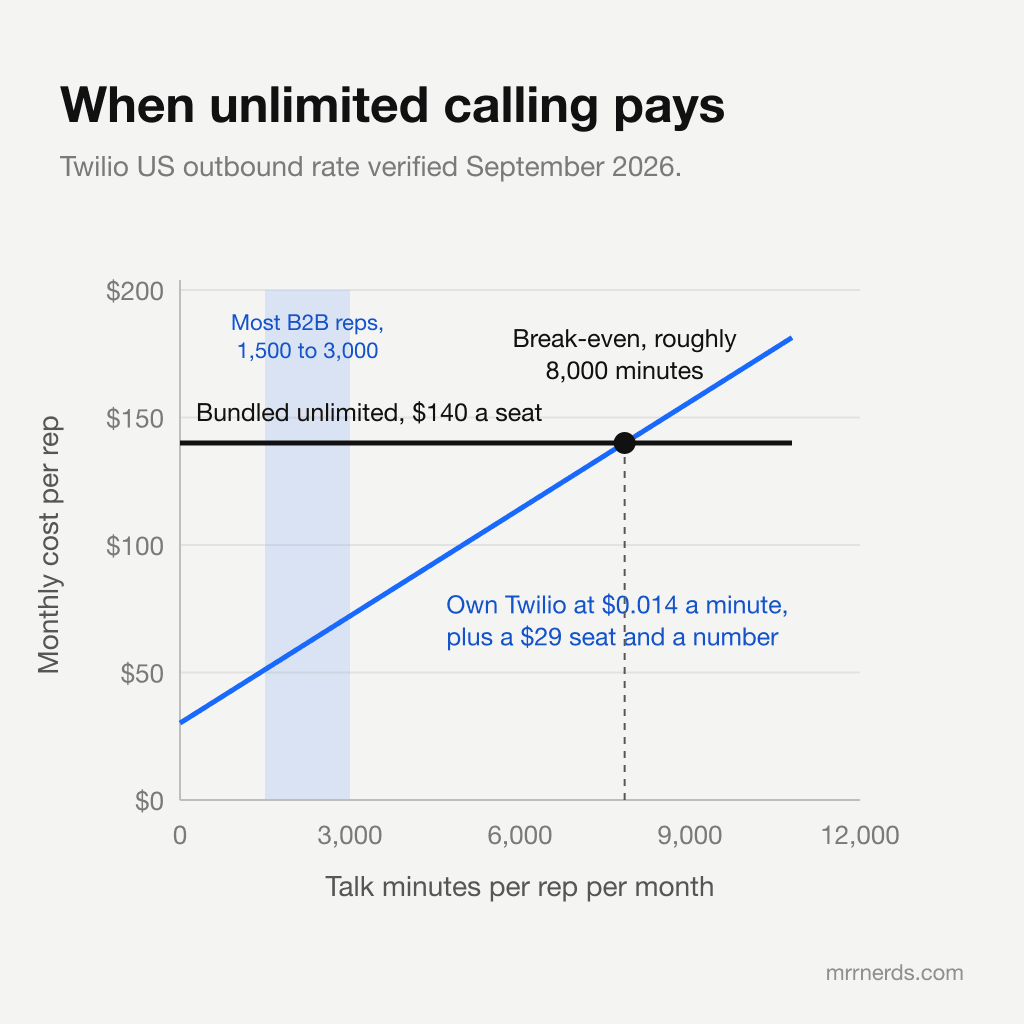
Chart of where paying Twilio $0.014 a minute stops being cheaper than a $140 unlimited seat: the lines cross near 9,000 talk minutes a month, far above the 1,500 to 3,000 most reps use.
Bundled unlimited calling at $140 a seat beats wholesale telephony at $0.014 a minute only above roughly 9,000 talk minutes a month. Twilio US outbound rate verified September 2026.

The shortlist at a glance

Every price below was read off the vendor's own pricing page or a dated third-party pricing guide on 2026-09-04. Where a vendor gates pricing behind a demo, we say so rather than guessing.

DialerFromBring your own TwilioFree planMinutesScoreLink
1.DialSheetSponsor
FreeYesYesYour carrier4.6Visit
$27/user/moYes14-day trialYour carrier3.8Visit
$21/user/moSIP only14-day trialMetered3.7Visit
$65/user/moSIP only14-day trialIncluded3.2Visit
Prices are the cheapest published tier per user per month unless stated. Telephony is billed separately on any tool marked as bring-your-own-carrier.
1

DialSheet

SponsorOpen source

Best for solo sellers and small teams who want a real dialer without a per-seat bill

A browser power dialer and CRM with a genuinely free forever plan, that runs on your own Twilio account so you pay wholesale for minutes instead of a marked-up seat price.

4.6/ 5

Free plan

What works

  • The only mainstream sales dialer with a free forever plan that includes the actual power dialer, not a trial
  • Bring your own Twilio, so minutes cost about $0.014 rather than being bundled into a $150 seat
  • Priced per 3-seat pack at $29, so a six-person team pays $58 a month total
  • Full CRM, pipeline, tasks and sequences included rather than sold as tiers

What does not

  • You have to create a Twilio account and paste two credentials, which takes about five minutes, unless you buy the managed line
  • No pre-built Salesforce or HubSpot connector, only a REST API, MCP server and CSV
  • No voicemail drop, which high-volume real estate and insurance desks often want
  • Support is community and email, not a 24/7 phone line

Our take

Paste an Account SID and auth token and DialSheet provisions the API key and TwiML app for you, in about five minutes. Free forever for one user, $29 a month for three seats, and open source under MIT so you can self-host. No pre-built Salesforce or HubSpot connector and no voicemail drop.

Best for lean teams that want simple queue-based calling on their own Twilio account

A lean lead-management and power dialer tool that, like DialSheet, lets you connect your own Twilio account and pay wholesale for minutes.

3.8/ 5

From $27/user/mo

What works

  • Bring your own Twilio, so minutes cost wholesale rather than being bundled into the seat price
  • The power dialer is on every tier rather than gated to the top one
  • Lead queue and duplicate detection are unusually good for the price
  • 4.7 on Capterra across 99 reviews

What does not

  • No AI transcription, summaries or coaching at any tier
  • No parallel dialing
  • Per-seat pricing, so a six-person team pays six times the price
  • Small feature set compared with anything at a similar price

Our take

Connects to your own Twilio account, with the power dialer on every tier from $27 a seat and a strong queue-based lead model. No AI transcription, summaries or coaching at any tier, and per-seat pricing means six people cost $162 a month.

Best for European teams that want SIP bring-your-own-carrier and international numbers

A European call centre platform that supports bring-your-own-carrier and sells its power and parallel dialers as add-ons on top of the seat price.

3.7/ 5

From $21/user/mo

What works

  • Supports bring-your-own-carrier over SIP, which almost no sales dialer does
  • Parallel dialing up to ten lines as a €39 add-on, far cheaper than a dedicated parallel dialer
  • Very strong international number coverage
  • 4.4 on G2 across roughly 1,840 reviews

What does not

  • Both dialers are add-ons, so the real Expert-plus-parallel price is roughly €88 a user
  • Pricing is shown in euros to every visitor including US buyers
  • Outbound minutes are capped below the top tier
  • Three-seat minimum on Expert

Our take

SIP trunk BYOC rather than a Twilio API connection, aimed at teams with a telecoms contact. Strong international coverage, and a ten-line parallel dialer as a €39 add-on. Both dialers are add-ons, so the honest Expert-plus-parallel price is about €97 a user.

Best for large organisations that already run RingCentral and need a contact centre

An enterprise phone system with no outbound dialer on any RingEX tier; dialing requires the RingCX contact centre at $65 an agent.

3.2/ 5

From $65/user/mo

What works

  • Bring-your-own-carrier support in 44 or more countries
  • Enterprise-grade reliability and compliance posture
  • One vendor for phone, meetings, messaging and contact centre

What does not

  • No outbound dialer on any standard phone tier, which surprises most buyers
  • RingCX at $65 an agent is a contact centre purchase, not a sales tool purchase
  • Quality management, workforce management and AI are all separately quoted modules
  • Implementation fees are common

Our take

Bring-your-own-carrier in 44 or more countries at enterprise scale. But no outbound dialer exists on any RingEX phone tier, so dialing means buying RingCX at $65 an agent, which is a contact centre purchase.

Why bring your own Twilio at all

Two reasons, and only one of them is money.

The minutes cost what they cost. Twilio charges $0.0140 a minute for US local outbound, $0.0085 inbound, $1.15 a month for a local number and $2.15 for toll-free. Those are published, pay-as-you-go rates that fall further with committed volume. A vendor that bundles telephony into a $150 seat is charging you a margin on top of roughly those same wholesale rates.

The numbers are yours. This is the reason that matters more over time. On a bring-your-own-Twilio setup, the phone number is registered to your Twilio account, the recordings sit in your Twilio storage, and leaving the software vendor is a matter of pointing a different app at the same account. On every other model, leaving means porting numbers, which is a process, and Kixie's public review corpus in particular is full of people who discovered that at the worst moment.

The arithmetic

Here is a five-rep team, each dialing 150 numbers a working day, at a 5 percent connect rate, 22 percent voicemail rate and 2.5 minutes of average talk time.

Line itemMonthly
Billable minutes (voicemails bill a full minute each)~5,400
Twilio minutes at $0.014~$76
Five local numbers at $1.15~$6
Telephony total~$82
Software, pack-priced at $29 per 3 seats$58
All in~$140/month for five reps

The same five seats cost $700 a month on PhoneBurner Standard, $475 on Kixie's multi-line tier before add-ons and $495 on Close Growth plus metered minutes.

Note the billing detail most cost calculators skip: carriers bill per call rounded up to the whole minute, and a voicemail that picks up bills a full minute even if you hang up in ten seconds. Unanswered rings cost nothing. Skipping that line is why other people's estimates run low.

What the setup actually involves

For the Twilio API tools it is five minutes and three steps.

  1. Create a free Twilio account and add a payment method. Twilio's trial credit works for testing but trial accounts can only call verified numbers, so a real cold calling setup needs a funded account.
  2. Copy the Account SID and auth token from the Twilio console.
  3. Paste them into the dialer. DialSheet provisions the API key and TwiML application automatically from there.

Then buy a local number in the area code you want to appear from. That is $1.15 a month and takes about thirty seconds.

For the SIP tools, CloudTalk and RingCentral, it is a genuine telecoms configuration and you want someone comfortable with SIP trunking.

Where this model loses

Be honest about three things.

It is five minutes of a telephony console. For some buyers that is a genuine barrier, and it is why DialSheet also sells a managed line at $49 a seat with a number and 1,500 minutes included. At that price the cost advantage mostly disappears, so most people should do the five minutes.

Twilio bills you separately. Two invoices instead of one. Finance teams sometimes object to that more than to the cost.

You own the compliance. Your Twilio account, your caller ID, your STIR/SHAKEN attestation, your responsibility if the number gets flagged. Bundled vendors handle some of that for you, and some of them do it well.

Twilio versus a managed line: the break-even

If a vendor offers both, the break-even is worth computing rather than guessing.

A managed line at $49 a seat with 1,500 minutes included, against $29 for three seats plus wholesale Twilio, breaks even somewhere around 3,300 billable minutes a month for a single user. Below that, bring your own Twilio and pay less. Above it, the managed line is simpler and roughly the same price.

Most B2B reps use 1,500 to 3,000 billable minutes a month, which puts almost everyone on the bring-your-own side of that line.


Frequently asked questions

Which power dialers let you bring your own Twilio account?
DialSheet and Myphoner connect directly to your own Twilio account over the Twilio API. CloudTalk, RingCentral, Five9 and Talkdesk support bring-your-own-carrier over SIP, which is a more technical trunk configuration. Orum, Nooks, Salesfinity, Kixie, PhoneBurner, Close, Aircall and JustCall all provide the telephony themselves and do not allow it.
How much does Twilio cost for cold calling?
Twilio charges $0.0140 a minute for US local outbound, $0.0085 a minute inbound, $1.15 a month for a local number and $2.15 for a toll-free number, on pay-as-you-go pricing verified September 2026. A rep dialing 150 numbers a working day with a 5 percent connect rate and 2.5 minutes of average talk time uses roughly 1,100 billable minutes a month, which is about $16.
How long does it take to connect Twilio to a dialer?
About five minutes. You create a free Twilio account, add a payment method, copy the Account SID and auth token from the console, and paste them into the dialer, which provisions the API key and TwiML application for you. Buying a local number takes another thirty seconds and costs $1.15 a month.
Is a Twilio trial account enough for cold calling?
No. Twilio trial accounts can only place calls to numbers you have verified in advance, which makes cold calling impossible by definition. You need to add a payment method and upgrade the account, after which you pay only for what you use at roughly $0.014 a minute.
Why do so few dialers support bring your own Twilio?
Because most dialer vendors make margin on the minutes. A vendor that bundles telephony into a $150 seat is reselling roughly $0.014 wholesale minutes at a markup, and letting customers buy them directly removes that revenue. Tools that support it, including DialSheet and Myphoner, monetise the software instead, which is a different business model rather than a more generous one.
Is there an open source power dialer?
DialSheet is MIT licensed and self-hostable, which makes it the main open-source option built for sales rather than call centres. VICIdial, OSDial and GOautodial are the long-standing open-source dialers, but they are call centre platforms requiring server administration and Asterisk knowledge, not tools a sales team can run on its own.

Keep reading

How we made this list

We price every dialer on total cost of ownership, which means the seat price plus the telephony, because the telephony is the half most vendor listicles omit. Scores are weighted across value, dialing engine, CRM depth, setup and support, applied identically to every tool. Prices are re-verified against vendor pricing pages every quarter and the date is on every page. Sponsors do not see or approve reviews before publication, and paying for a placement does not change a score. Read the full methodology or our editorial policy.