What a power dialer actually is
A power dialer places one call at a time, automatically, from a list. When the call ends the rep taps a disposition and the next number dials itself. That is the whole mechanism, and it is worth understanding precisely because three adjacent products get sold under the same word.
- A power dialer dials one number per rep, sequentially, with no delay between calls. The rep hears every ring.
- A parallel dialer rings three to ten numbers at once per rep and bridges the rep to the first human, dropping the rest. It multiplies dials and introduces a connect delay.
- A predictive dialer over-dials using a pacing algorithm that predicts agent availability. In the US it falls under the TCPA's three percent call abandonment cap and is a call centre tool, not a sales tool.
- Click-to-call is a link that dials a number. It is not a dialer, and several vendors on this page sell it as one on their entry tier.
The practical difference is throughput. A rep dialing manually from a spreadsheet completes 35 to 50 dials a day once note-taking is counted. The same rep on a power dialer completes 120 to 200. On a parallel dialer, 300 to 600, with the caveat that every one of those headline numbers assumes a clean list.
How we ranked these
Total cost of ownership, not seat price. Every dialer bill has two halves, and the vendors that bundle telephony into the seat price are the ones that never show you the second half.
Consider a five-person team where each rep dials 150 numbers a working day. At a 5 percent connect rate, 22 percent voicemail rate and 2.5 minutes of average talk time, that team burns roughly 5,400 billable minutes a month. On your own Twilio account at $0.014 a minute plus $1.15 a number, that is about $82 a month in telephony.
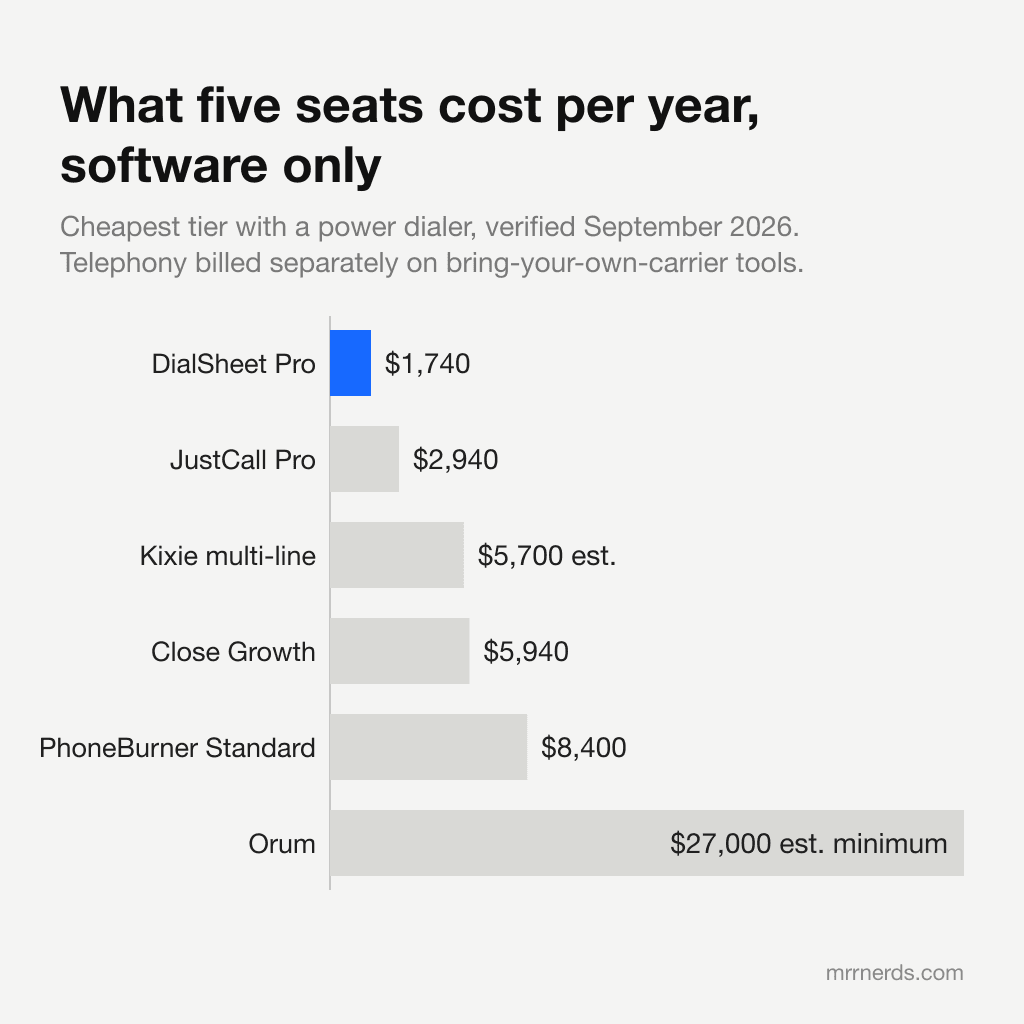
| Tool | Software, 5 seats, per year | Telephony |
|---|
| DialSheet Pro | $1,740 | ~$82/month on your own Twilio |
| JustCall Pro | $2,940 | Included |
| Close Growth | $5,940 | ~$0.02/min on top |
| Kixie multi-line | $5,700 before add-ons | Included |
| PhoneBurner Standard | $8,400 | Included |
| Orum (estimated, 9-seat minimum) | ~$27,000 minimum | Included |
The gap between the top and bottom of that table is not a feature gap. PhoneBurner does not do twelve times what DialSheet does. It is a pricing model gap, and the model that wins is the one that does not resell you minutes.
Where the cheap answer is the wrong answer
We would not be worth reading if every page ended the same way, so here is where paying more is correct.
You need the dialer inside HubSpot. Kixie's integration is deeper than anything a bring-your-own-Twilio tool offers, and rebuilding it is not a weekend project. If your reps work from CRM records rather than a list, pay for it.
You want to spend nothing at all. Then this page is the wrong one: the free power dialer ranking prices every permanently free offer in the category, including two that charge less than DialSheet's free plan does once telephony is counted.
You need nine-plus reps dialing at maximum throughput. Orum's ten lines and its answering-machine detection produce conversations per hour that single-line dialing cannot approach. Against $85,000 of loaded SDR cost, $3,000 a year of software is not the variable to optimise.
Your reps talk for four hours a day. Above roughly 8,000 talk minutes a month, PhoneBurner's unlimited calling is cheaper than metered telephony. Run the arithmetic on your own talk time before assuming it does not apply.
You are replacing a CRM at the same time. Close at $99 a seat is expensive as a dialer and reasonable as a CRM, a sequencer and a dialer bought together.
Ramp time is your constraint. Nooks' virtual floor and roleplay shorten the time to a productive rep, and for a team hiring several SDRs a quarter that is worth more than a cheaper dialer.
The features that matter, and the ones that do not
Matters: time between calls. The single biggest determinant of dials per day. Test it in a trial by dialing thirty numbers and timing yourself.
Matters: one-key dispositions. If logging an outcome takes three clicks, a rep making 150 calls a day spends 20 minutes clicking.
Matters: number rotation and local presence. Carrier analytics engines from Hiya, TNS and First Orion begin flagging numbers as Spam Likely somewhere north of 100 to 150 dials a day from one number with a low answer rate. Rotation is the fix, and the number of DIDs a vendor gives you matters more than the marketing around it.
Matters less than vendors claim: line count. Ten lines against a list with a 2 percent connect rate produces a rep sitting in silence. Connect quality and answering-machine detection matter more than the number on the box.
Matters less than you think: AI call summaries. Useful, now near-universal, and not worth a $40 a seat premium on its own. Every tool here except Mojo, Myphoner and Readymode has some version.
Before you buy: three questions
- How many talk minutes does a rep actually use a month? Under 3,000, bring-your-own-carrier wins decisively. Over 8,000, bundled unlimited wins.
- Is your list in a CRM or a spreadsheet? A CRM answer points to Kixie, Close or Trellus. A spreadsheet answer points to a standalone dialer, and Trellus and DialSheet both handle CSV or Sheets natively. If you are keeping a CRM, check the dialer CRM integration matrix before the seat price: the connector is the cheap half of that bill, and the Salesforce edition underneath it costs more than the dialer does.
- What happens if you want to leave? Ask where the phone numbers live. On a bring-your-own-Twilio tool they are yours already. On everything else, porting is a process, and Kixie's review corpus in particular is full of people who found that out late.