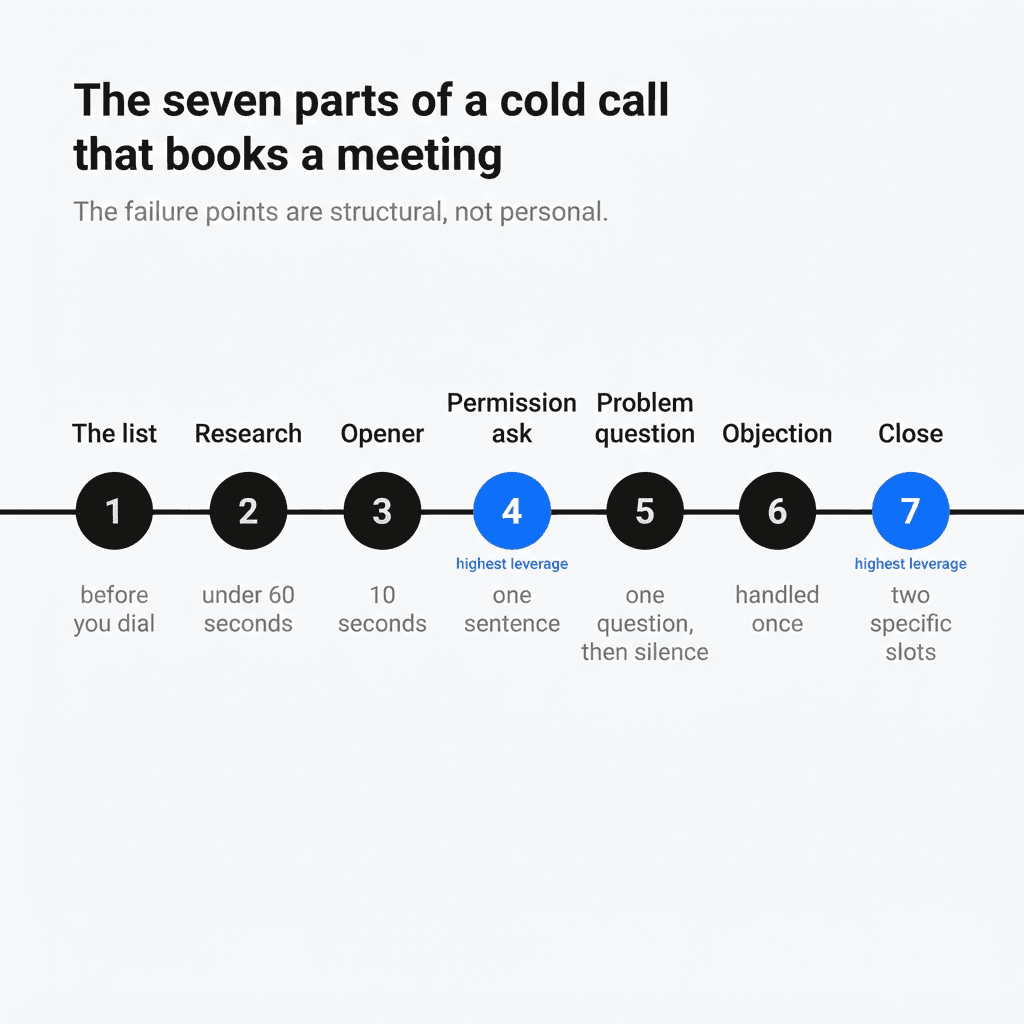
Cold calling fails for structural reasons, not personal ones. A rep who "isn't good on the phone" is almost always a rep working from a bad list, opening with a script that triggers a reflex hang-up, or asking for a meeting before establishing there is anything to meet about. Each of those is fixable in an afternoon.
This guide covers the seven parts of a call that works, in the order they happen. Read it once end to end, then use it as a checklist against a recording of your own calls.
The seven parts of a cold call
Every cold call that ends in a booked meeting has the same skeleton:
- The list. Who you dial, and whether the number is real.
- The research. Under 60 seconds, one specific fact.
- The opener. Ten seconds, plain about what this is.
- The permission ask. The sentence that does the most work in the whole call.
- The problem question. One question, never a pitch.
- The objection. Handled once, then dropped.
- The close. A specific slot, never agreement in principle.
Reps who skip parts 4 and 7 have the worst numbers. Part 4 is what stops the hang-up. Part 7 is what turns interest into a calendar event.
Part 1: The list decides your day before you dial
The single largest variable in cold calling outcomes is whether the person you dialed is a plausible buyer and whether the number reaches them. Skill comes a distant second.
A list with 30% bad numbers costs a rep roughly a third of their day for zero return, and it damages the number they are dialing from, because carrier analytics engines read a high rate of unanswered and invalid calls as spam behaviour. Before you dial a list of any size:
- Check the shape of the number. Anything that is not a valid, correctly formatted number in E.164 (like
+14155551234) will fail at the carrier and still count against you. - Scrub against the DNC registry if you are calling consumers in the US, and against the equivalent register in your market. This is a legal requirement, not a best practice.
- Deduplicate ruthlessly. Calling the same person twice from two rows makes you look careless in the one situation where you cannot afford to.
- Sort by likelihood of answering. Direct dials before switchboards, mobiles before landlines for founders, landlines before mobiles for office-based roles.
If you are buying data, buy a sample of 200 records first and dial them before you buy 20,000. Every list vendor's accuracy claim is written by their marketing team; the only accuracy number that matters is the one you measure.
What a realistic list looks like
For B2B outbound to companies of 20 to 500 people, a healthy list produces:
| Metric | Healthy range | What it means |
|---|---|---|
| Invalid / disconnected | Under 8% | Data is fresh |
| Reaches a human | 4 to 8% of dials | Normal B2B connect rate |
| Reaches a voicemail | 20 to 30% of dials | Expected; not a failure |
| Right person, wrong role | Under 15% | Targeting is accurate |
If your connect rate is under 2%, the problem is almost never your opener. It is the list, the time of day, or the fact that your number has been flagged.
Part 2: Sixty seconds of research, not ten minutes
Research has sharply diminishing returns. The purpose is to find one specific, checkable fact you can name in the first fifteen seconds so the call does not sound like a broadcast. One is enough. Two is showing off.
Good facts, in rough order of usefulness:
- They are hiring for a role that implies the problem you solve
- They recently announced funding, an office, an acquisition or a product
- A named peer competitor already buys what you sell
- Something they personally posted or said publicly in the last month
- A visible property of their business, such as number of locations, a job board, or a stack detail
Bad facts: their company's founding year, the boilerplate on their About page, their headcount from a data provider. Everyone uses those, and prospects can hear it.
Cap the research at 60 seconds per prospect. If you cannot find something in a minute, dial anyway with a generic-but-opener. A rep who researches for ten minutes per call makes twelve dials a day and has no data to learn from.
Part 3: The opener, and why "did I catch you at a bad time" loses
You have about ten seconds before the prospect decides whether this is a call or an interruption to be ended. The three things that make an opener survive that window:
Name yourself and your company immediately. Anonymity reads as a scam call. "It's Alex from Northwind" costs you two seconds and buys you the benefit of the doubt.
Acknowledge that this is a cold call. This is counterintuitive and it is the highest-return change most reps can make. The prospect already knows. Naming it yourself defuses the thing they are bracing for.
Do not ask "did I catch you at a bad time." Across 90,380 cold calls, Gong Labs found it booked meetings 0.9 percent of the time against a 1.5 percent baseline (Gong Labs, 2018). "How are you?" did better than its reputation at 5.2 percent, and a permission-based opener beat both at 11.18 percent in Gong's 2024 data. The full table is in cold call opening lines.
Three openers that hold up, in ascending order of directness:
"Hi Sarah, it's Alex from Northwind. I know I'm an interruption. Can I have 30 seconds to tell you why I called, and then you can tell me to go away?"
"Hi Sarah, Alex from Northwind. This is a cold call. Do you want to hang up, or do you want the 30-second version?"
"Sarah? Alex from Northwind. I called because you're hiring three AEs this quarter and I have a specific reason to think your ramp time is going to hurt. Can I take a minute?"
The third only works when the research fact is specific. If it is not, use the first.
Part 4: Ask permission, then actually honour it
The permission ask, "can I have 30 seconds" or "is now a terrible time", is the sentence that does the most work in the call, for a reason that has nothing to do with politeness. It converts the prospect from someone being talked at into someone who made a decision. People who agree to give you 30 seconds listen to the 30 seconds.
Two rules make it work:
Ask for a real, small amount of time. Thirty seconds. Not "a few minutes of your time", which everyone knows is a lie.
Honour it. At thirty seconds, stop and check in. "That's my thirty. Want me to keep going?" Reps who blow through their own stated limit teach the prospect that nothing they say is reliable, in the first minute of the relationship.
If they say no, ask exactly one question before you go: "Totally fair. Is it a bad time, or a bad fit?" The answer is worth more than the call. "Bad time" is a callback with a reason. "Bad fit" tells you your list is wrong.
Part 5: One problem question beats any pitch
The mistake nearly every new rep makes here is delivering the value proposition. The prospect has no reason to care about your product yet, because you have not established that they have the problem it solves.
Ask one question. It should be:
- Specific to their world, using their vocabulary, not yours
- About a problem, not about your category
- Answerable in a sentence, so it does not feel like a survey
Weak: "Are you looking to improve your sales productivity this year?" Strong: "When you hired those three AEs, how long is it taking them to get to their first closed deal?"
Weak: "Do you use a dialer today?" Strong: "How is your team getting through a list of 500 numbers right now? Is someone typing them in?"
Then stop talking. The silence after a good question is where the call is won. Most reps fill it within two seconds and destroy the question they just asked.
Part 6: The objection is a reflex, not a decision
The first objection in a cold call is almost never a considered position. "Not interested", "we already have something", "send me an email" are reflexes fired before the prospect has processed what you said. Treat them as such.
The pattern that works: acknowledge, reframe once, ask. Never argue, and never handle the same objection twice.
| Objection | What it usually means | One response that works |
|---|---|---|
| "Not interested" | I haven't processed anything you said | "That's fair, you don't know what this is yet. One sentence and you can decide." |
| "We already use [competitor]" | This is my exit line | "Good, that means the problem is real. What made you pick them?" |
| "Send me an email" | I want this call to end politely | "Happy to. So I don't send you something useless, what would need to be in it?" |
| "I don't have time" | Genuine, or a reflex | "Understood. Is Thursday morning better, or is this just not a thing for you?" |
| "How did you get my number?" | Suspicion | Answer and briefly, then move on. Evasion here ends the call. |
| "We have no budget" | Too early to be real | "Makes sense. I'm not asking for budget, I'm asking for fifteen minutes." |
Handle it once. If it comes back a second time, it has become a position. Thank them and get off the phone. Reps burn their reputation and their afternoon arguing with the second objection.
Part 7: Close for a specific slot
"Would you be open to a chat sometime next week?" is not a close. It produces agreement without a commitment, and agreement without a commitment produces nothing.
Offer two specific times, in their time zone, and shut up:
"Thursday at 2, or Friday at 10:30, which is easier?"
Then, before you hang up, do three things that most reps skip and that account for a large share of no-shows:
- Send the invite while you are still on the phone. Say you are doing it. "Sending it now, you should see it in a second. Got it?"
- Confirm the attendee list. "Is it just you, or should I include anyone else?"
- State the agenda in one sentence. "Fifteen minutes, I'll show you how the ramp piece works, and you can tell me if it's relevant."
A meeting booked without an invite in hand is a meeting that is 40% likely to happen.
What to do with the 95% who don't answer
At a 5% connect rate, nineteen of every twenty dials do not reach a human. What you do with those decides whether your week compounds or resets.
Voicemail: leave two at most, and point them at an email. Gong Labs' 2024 analysis of a stated 300M+ cold calls found that one or two voicemails lift the email reply rate from 2.73 to 5.87 percent, cut the connect rate on later dials by 28 percent, and that from the third voicemail on, replies fall to 2.2 percent. Keep each under 30 seconds, name you and your company, and give one reason to read the email. Callbacks are rare enough that they should not be the goal. The scripts are in the voicemail guide.
The follow-up sequence: a dial with no answer should automatically create the next touch. Five dials across two to three weeks, varying the day and the hour, covers the roughly three attempts most published data says reaching a prospect takes, with room for the long tail. Attempt two on the same day at a different hour is worth more than attempt two next Tuesday at the same hour.
Notes: write the disposition immediately, in one click if your tooling allows it. A call you cannot remember the outcome of is a call you did not make.
This is the part where tooling stops being a nicety. A rep tracking five-dial cadences across 400 prospects in a spreadsheet will drop most of them. A dialer that auto-advances, logs the outcome and schedules the next attempt turns the 95% into a compounding asset rather than a pile of dead rows.
The numbers to hold yourself to
Track these five weekly. Nothing else.
| Metric | Healthy B2B benchmark |
|---|---|
| Dials per rep per day | 120 to 200 (power dialer), 35 to 50 (manual) |
| Connect rate | 4 to 8% |
| Conversation to meeting | 10 to 20% |
| Meetings held vs booked | Over 70% |
| Dials per prospect before moving on | At least 3; 93% of conversations happen by the third (Cognism, 2025) |
The most common failure is a rep making 40 dials a day, getting two conversations, and concluding from a sample of two that cold calling does not work.
The five mistakes that account for most bad calls
- Pitching before permission. The prospect has not agreed to listen yet.
- Talking more than 55% of the time. The best discovery calls run about 43% rep, 57% prospect.
- Accepting the first objection as final. It is a reflex, and it is worth exactly one reframe.
- Closing for agreement instead of a slot. "Sometime next week" is a no with better manners.
- Working a list nobody validated. No opener survives a wrong number.
What to do this week
- Pull a recording of three of your own calls and mark where each of the seven parts happened, or didn't
- Rewrite your opener to name yourself, name the cold call, and ask for 30 seconds
- Pick one problem question and use it on every call for a week
- Set your follow-up cadence to five dials across three weeks, varying the hour
- Count your dials. If it is under 60 a day and you are dialing by hand, the tooling is the constraint, not you
Frequently asked questions
- How many cold calls a day should a rep make?
- A full-time SDR dialing a clean list should complete 120 to 200 dials a day using a single-line power dialer, or 300 to 600 using a parallel dialer running three or four lines. Dialing manually from a spreadsheet or CRM, the same rep completes 35 to 50, because most of the day goes to looking up numbers, typing them and writing notes rather than talking. The number that matters is not dials but conversations: at a 5% connect rate, 150 dials is roughly seven or eight real conversations.
- What is the best opening line for a cold call?
- The most reliably effective opener names yourself and your company, states plainly that this is a cold call, and asks for a short window of time: "Hi Sarah, it's Alex from Northwind. I know I'm an interruption. Can I have 30 seconds to tell you why I called, and you can tell me to go away?" It works because it is it lowers the prospect's guard by acknowledging the interruption, and it gives them an explicit exit, which is what makes them stay on the line.
- How long should a cold call be?
- A cold call that ends in a booked meeting averages five to six minutes. Calls under two minutes usually mean the rep never got past the opener, and calls beyond ten minutes usually mean the rep is delivering the demo on the phone instead of booking one. The goal of the call is the next call, not the sale.
- What is the best time of day to cold call?
- Late afternoon, between 4pm and 5pm in the prospect's own time zone, produces the highest connect rates, with 11am to 12pm the second-best window. The worst times are the first hour of the morning, when people are clearing email, and the hour after lunch. Time zone matters more than the hour itself: a rep in New York dialing the West Coast at 9am is calling people who are still asleep.
- How many attempts does it take to reach a prospect?
- About three, in most published data. Cognism's 2025 report of more than 204,000 calls found 2.9 attempts on average, with 93 percent of conversations happening by the third call, and its 2026 report puts it at 1.55. Saleshandy's 7,699 calls in 2026 averaged 3.51 attempts with a median of 2. Spread the attempts across days and hours, because a prospect who does not answer at 10am on Tuesday may pick up at 4pm on Thursday.
- Is cold calling still effective in 2026?
- Yes, for B2B sales to companies with more than a handful of employees. 57% of C-level and VP buyers say they prefer to be contacted by phone, a higher share than any other seniority level. Cold calling has become more effective in relative terms as inboxes have filled: a well-researched call now competes against far less noise than a cold email does. It is much weaker for low-ticket consumer sales, where regulation and call screening have made it impractical.
How to cite this page
Abhi Chawla. "How to cold call: the complete guide for 2026." MRR Nerds, 2026-10-03. https://www.mrrnerds.com/guides/how-to-cold-call. Accessed 2026-10-16.
The underlying vendor data is published at /data under CC BY 4.0. Cite the dataset for numbers, this page for the analysis.