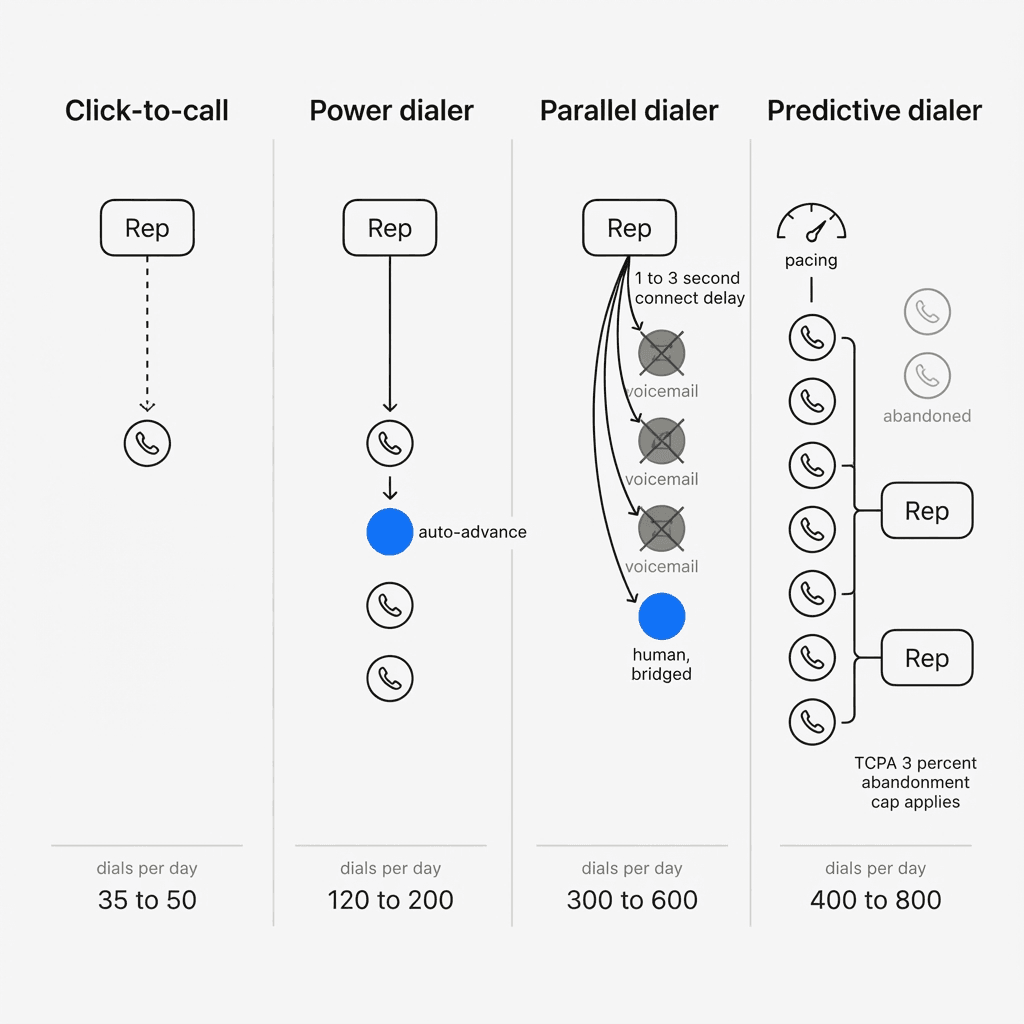
How parallel dialing actually works
The dialer opens several lines per rep simultaneously. Software listens to each line, classifies what picks up as a human, a voicemail greeting or an automated system, drops everything that is not a human, and bridges the rep to the one that is.
Two consequences follow from that mechanism, and they are the whole story of this category.
The connect delay. Classification takes time. Between the prospect saying hello and the rep being connected, there is a pause, typically one to three seconds. Every vendor works to shorten it and none has eliminated it. A prospect who says hello twice into silence hangs up, and the vendors with the most complaints about this are the ones whose classification is slowest.
The abandoned calls. If two humans answer at once, one gets dropped. That person receives a silent call from your number. Repeat that a few hundred times a day and carrier analytics engines start treating your number the way they treat a robocaller.
The number reputation problem
This is the cost nobody puts on the pricing page.
Carrier analytics engines, Hiya for AT&T, TNS for Verizon and First Orion for T-Mobile, score numbers independently on behavioural signals: call volume, call duration, answer rate and abandonment. Short calls, unanswered calls and abandoned calls all read as robocall behaviour. Parallel dialing generates all three by design.
Clearing a spam label with one engine does not clear it with the others, and there is no single place to fix it. STIR/SHAKEN attestation, which authenticates that a carrier knows you and that you have the right to use the number, does not prevent a Spam Likely label if your behaviour looks like a robocaller's.
The engineering answer is number rotation across a large pool, and the vendors that take it seriously say so: Readymode includes 30 to 75 DIDs per licence and sells Autopilot rotation, Koncert sells managed caller ID reputation with a health heat map, Ricochet sells Spam Guru at $2 to $4 a number. If a parallel dialer vendor cannot tell you how many numbers you get and how rotation works, that is the question to press.
The compliance line
Parallel dialing is generally not an automatic telephone dialing system under the federal TCPA following Facebook v. Duguid in 2021, which held that the equipment must use a random or sequential number generator. A list-based parallel dialer does not. That is the reason this category exists at all.
Two caveats matter. State mini-TCPA statutes, notably in Florida and Oklahoma, define autodialers more broadly than the federal standard, and calling into those states carries different exposure. And predictive dialing, which is a different thing, remains subject to the three percent call abandonment cap. Statutory damages under the TCPA are $500 per call, trebled to $1,500 for willful violations, with no cap, and roughly 80 percent of suits are class actions.
This is orientation, not legal advice. If you are dialing consumers at volume, get counsel.
When parallel dialing pays and when it does not
Run this arithmetic before you buy.
A rep on a single-line power dialer completes about 150 dials a day. At a 5 percent connect rate that is seven or eight conversations. On four lines, the same rep completes about 450 dials and gets 22 conversations, less the ones lost to connect delay, call it 18.
So parallel dialing roughly doubles to triples conversations per rep-day. Against a fully loaded SDR cost of about $85,000 a year, that is worth a lot, and $299 a month is cheap.
Now change one variable. If the connect rate is 2 percent rather than 5, the same rep on four lines gets seven conversations instead of three, and spends most of the day listening to a dialer classify voicemails. The list quality decides whether this category is worth anything to you, and no vendor's demo runs on your list.
That is precisely why Salesfinity's month-to-month terms matter more than its price, and why Orum's 500-dial trial is not an evaluation.
The cheaper thing to try first
Most teams that go shopping for a parallel dialer are actually solving one of two other problems: their reps are not dialing enough because the tooling is slow, or their list is too small to justify the volume.
If a rep is making 40 dials a day, the fix is a power dialer, not a parallel one. Going from 40 to 150 dials a day is a bigger absolute change than going from 150 to 450, it costs a hundredth as much, and it does not put your numbers at risk. Prove the power dialer maxes out first.