The rule every other page on this query leaves out
Nine pages rank for this search. Eight are published by companies selling a dialer and one is an AI content farm. All nine compare seat prices and feature checklists. None mentions the requirement that decides the purchase for anyone selling Medicare Advantage.
An agent or broker compensated to do lead generation, marketing, sales or enrollment work in Medicare Advantage is a Third Party Marketing Organization under 42 CFR 422.2260 and 423.2260. CMS puts it plainly in its own marketing FAQ: the definition "includes all organizations and individuals, including independent agents and brokers, who are compensated to perform lead generation, marketing, sales, and enrollment related functions as a part of the chain of enrollment."
Three obligations follow, and each one is a line item in a dialer contract.
Record everything. 42 CFR 422.2274(g)(2)(ii) requires a TPMO to "Record all marketing, sales, and enrollment calls, including the audio portion of calls via web-based technology, in their entirety." CMS answers the obvious dodges in the same FAQ. Does it apply only to call centres? "No." Does it cover captive agents? "Yes." Must an agent record all calls with enrollees even outside the chain of enrollment? "Yes. A plan must ensure that all calls between a TPMO and a beneficiary are recorded." Inbound as well as outbound? "Yes."
Keep it for 10 years. 42 CFR 422.504(d) says the organisation "agrees to maintain for 10 years books, records, documents, and other evidence". CMS has proposed cutting that to six years for contract year 2027. That proposal is not final and we could not reach a Federal Register citation for it, so 10 years is the number that binds a contract you sign this month.
Do it during the busiest seven weeks of your year. Medicare open enrollment runs October 15 to December 7, per medicare.gov. An agency searching this query in September is buying a phone system four weeks before every call it makes becomes a federal record.
If you sell property and casualty, life or commercial lines, none of that applies to you and the cheapest tool in the table below is the right answer. The rest of this page separates those two buyers, because every other page on this query treats them as one.
What three insurance agents actually cost, software and telephony together
Three agents, 150 dials each per working day, 21 working days. That is 9,450 dials a month. Assume a 5 percent connect rate, 22 percent voicemail, two and a half minutes of talk on a connect, and a carrier that bills every call rounded up to the whole minute. On your own Twilio account that is 3,497 billed minutes, about $49, plus $3 for three local numbers.
| Tool | Software, 3 seats | Telephony | All in, monthly | Call recording |
|---|
| DialSheet Pro | $87 | $52 on your own Twilio | $139 | Included, stored in your Twilio |
| Myphoner Basic | $81 | $52 on your own Twilio | $133 | Included |
| JustCall Pro | $147 | included | $147 | Included |
| CloudTalk Expert | $147 | included | $147 | Included |
| Apollo Basic | $147 | credits, 2 a minute | $147 plus credits | Capped, see below |
| Aircall Professional | $150 | unlimited US and Canada | $150 | Included |
| Kixie Single-Line, estimated | $195 | included | $195 | Included |
| RingCentral RingCX | $195 | included | $195 | Included |
| Mojo Triple Line | $297 | included | $297 plus $25 | Separate $25 add-on |
| Close Growth | $297 | metered at about $0.02 | about $367 | Included |
| PhoneBurner Standard | $420 | included | $420 | Included |
| Readymode Starter | $597 | included | $597 | Included |
Top to bottom that is a factor of five on the same 9,450 dials. Most vendor pages quote the seat price and leave telephony out, which understates the cheap end of this table and flatters the expensive end.
Where the recording rule turns a feature into a disqualifier
Two tools in that table have a recording problem, and pages currently ranking for this query recommend both.
Apollo caps recorded minutes, and the cap on the tier that has the dialer is 150 a month. Read from Apollo’s own pricing page on 18 September 2026: call recording is limited to 150 minutes a month on Free and on the $49 Basic tier, 4,000 on the $79 Professional tier and 8,000 on the $139 Organization tier, which also now states a three-seat minimum. Basic is the cheapest tier that carries the dialer at all. Three agents at the volume modelled above produce 3,497 billed minutes a month, so Basic covers about 4 percent of them and even Professional fits with almost no headroom. A rule that says record every call in its entirety and a plan that stops recording after two hours cannot both be satisfied, and two of the pages ranking above us recommend Apollo to insurance agents without mentioning it.
Mojo sells call recording separately. The dialer is $89 single line or $139 triple line on top of a $10 Agent Access fee, and call recording is a $25 a month add-on. For a real estate desk that is a preference. For a TPMO it is a compliance line item that has to be bought and can be forgotten.
Everything else in the table includes recording. That still leaves the question no vendor page answers and every Medicare agency has to ask: how long does the vendor keep the file, and what happens to it when you cancel? Three agents at this volume generate about 3,497 minutes of audio a month, so a 10-year obligation is roughly 420,000 minutes you are responsible for producing on request. Get the retention period and the export path in writing before you sign, because a dialer that deletes recordings 90 days after churn has handed you a 10-year problem.
One architecture lets you answer that yourself. On a bring-your-own-Twilio tool the recordings are written to your own Twilio account, so the retention policy is yours and cancelling the dialer does not touch the archive. That is a real advantage of the cheapest option in the table, and it is the narrow sense in which DialSheet suits a Medicare desk. The broader sense is the next section, and it goes the other way.
Where DialSheet loses on this page, precisely
Three cases, each with the number attached.
Recorded voicemail during open enrollment. DialSheet Pro now supports voicemail drop: record a message, confirm consent for prerecorded messages, and press V at the beep during a Power Dial call. The parallel dialer can leave the selected message after machine detection. PhoneBurner remains worth evaluating for its calling bundle and workflow, but voicemail availability is no longer a reason to exclude DialSheet.
Support during a seven-week season. DialSheet's support is community and email, with no 24 hour phone line. Every other tool in the top half of the table has one. An agency whose year turns on seven weeks should price what an outage costs on a Tuesday in November, and that number is usually larger than the difference in seat price.
Your pipeline lives in an agency management system. DialSheet ships a REST API, an MCP server, webhooks and CSV, with no pre-built connector to Applied Epic, AMS360, HawkSoft or Salesforce. Kixie's CRM integration beats anything a bring-your-own-carrier tool offers today. An agent who has to switch windows to log a call will stop logging calls, and for a TPMO the call log is evidence.
What insurance dialing looks like
An agency producer working aged leads, shared leads or a book renewal list dials between 300 and 1,000 numbers a week. Connect rates on aged consumer data are low, conversations are short, and the same record gets called several times over months.
That shape has three implications for tooling.
Volume matters, but list hygiene matters more. An aged list sold to six agencies is a list where every number has already been dialed forty times. Dialing it faster does not fix it. The tool that helps most is the one that lets you disposition ruthlessly and never call a dead record twice.
Callbacks are the business. "Call me after my renewal in March" is the highest-value outcome of most insurance calls, and it beats a same-day quote. A dialer without tasks and due dates loses those, and losing those is losing the book.
Recording consent is state law as well as federal. The TPMO rule above is separate from state wiretap law. Several states require all-party consent to record, so a dialer that records everything needs a recording notice in the opening, and the notice has to fire before the conversation starts. We have not built the state table for recording consent the way we have for calling hours, so check your own states rather than taking a count from any page, this one included.
Choosing by the list you dial
A property and casualty or life book you already own. Renewals, cross-sell, lapsed policies, referrals. No lead bill, so the seat price is the whole bill, and $139 against $420 for the same 9,450 dials is the entire decision.
A Medicare book outside open enrollment. Lower volume, every call recorded and retained. The recording architecture matters more than the seat price. Confirm retention and export in writing.
A Medicare desk inside open enrollment on purchased leads. Volume triples for seven weeks. Buy voicemail drop, unlimited calling and a phone support line, and accept the higher seat price for the season. PhoneBurner at $420 for three seats.
A floor of ten or more setters on bought leads. Predictive dialing with DID rotation and supervisor tooling, which is Readymode at $199 to $249 a licence, plus a compliance budget larger than the software budget.
Compliance is the other constraint
Insurance dialing is consumer dialing, which puts it at the sharp end of the TCPA.
The DNC is a legal requirement. Scrub before every campaign, not once when you buy the list.
Statutory damages are $500 per call, trebled to $1,500 for willful or knowing violations, with no cap, and roughly 80 percent of TCPA suits are class actions. A list of 10,000 improperly called numbers is a five-million-dollar theoretical exposure.
Predictive dialing carries the abandonment cap. The three percent limit applies, and predictive pacing generates abandoned calls by design. If you run a predictive floor, someone has to be accountable for the abandonment rate.
One-to-one consent is dead, and the relief is smaller than it sounds. The FCC rule requiring separate consent per seller was vacated by the Eleventh Circuit in Insurance Marketing Coalition v. FCC in January 2025, and the FCC reinstated the older prior-express-written-consent standard in August 2025. That standard still requires consent that is clear, conspicuous and provable, and a purchased insurance lead's consent record becomes your exposure the moment you dial it.
Calling hours are state law and they vary. The federal window is 8am to 9pm in the called party's time zone, and several states are narrower. The state table with the statute quoted for each one is on TCPA calling hours by state.
This is orientation and not legal advice. The regulatory text above is quoted from the Code of Federal Regulations and from CMS, and your counsel should see both before open enrollment starts.
Number reputation, which insurance agencies hit hardest
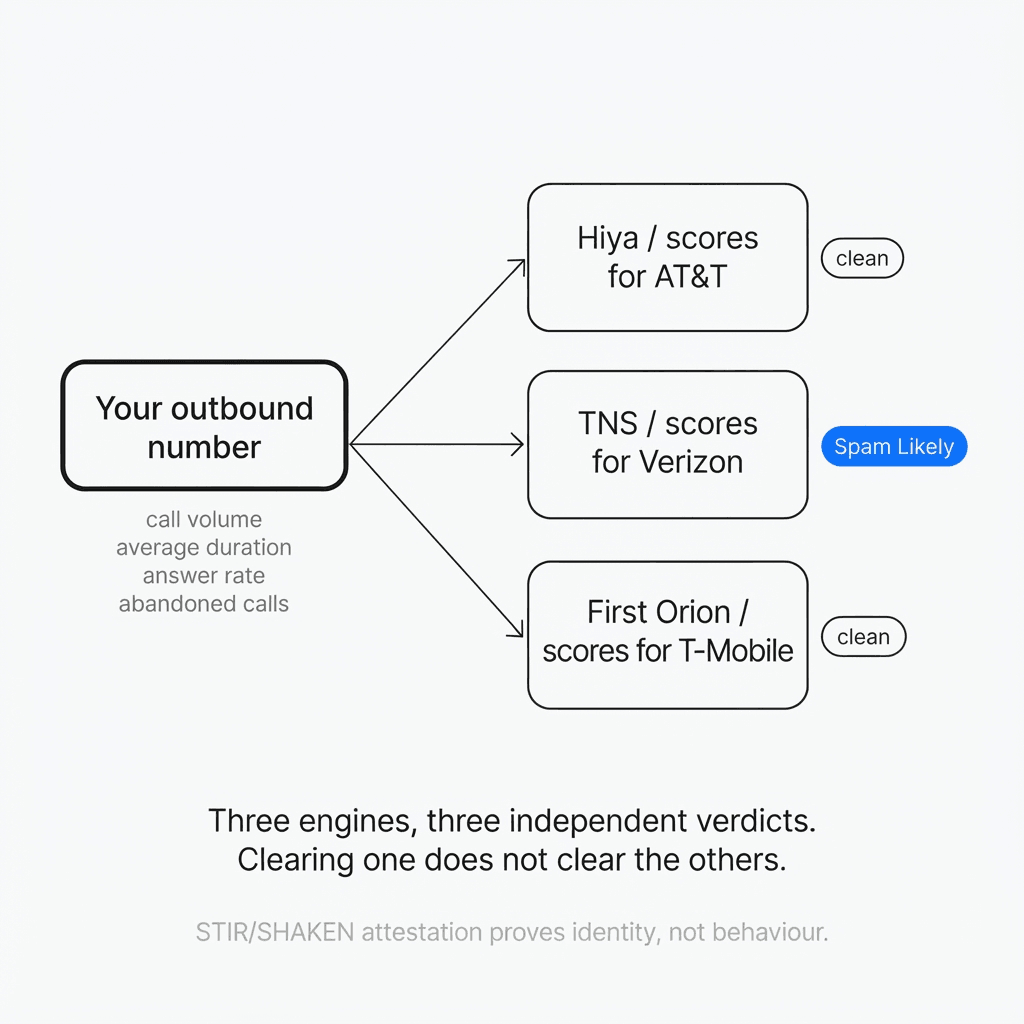
Consumer lists produce low answer rates, and low answer rates are exactly what carrier analytics engines score against you. An agency dialing 200 numbers a day from a single number will typically see a Spam Likely label within weeks.
The fixes, in order of effectiveness: rotate across several numbers, use local presence for the area code you are calling, keep call durations up by dialing better lists, and register your numbers for branded caller ID where your carrier supports it. Vendors that take this seriously give you DIDs in quantity. Vendors that do not will sell you a $10 caller ID add-on and call it done.
What to buy
Solo agent, own book. The free plan covers you to 500 calls a month. Past that, one $29 Pro seat plus about $17 of Twilio, roughly $46 a month at 150 dials a day.
Two to five agents, property and casualty or life, own book. DialSheet Pro plus Twilio, about $139 a month for three.
A Medicare agency heading into October 15. PhoneBurner for the drop, the unlimited calling and the phone support, at $420 for three seats, and get the recording retention period in writing before the season starts.
An agency that lives in Salesforce or an agency management system. Kixie, with the add-on list priced in writing before you sign an annual term.