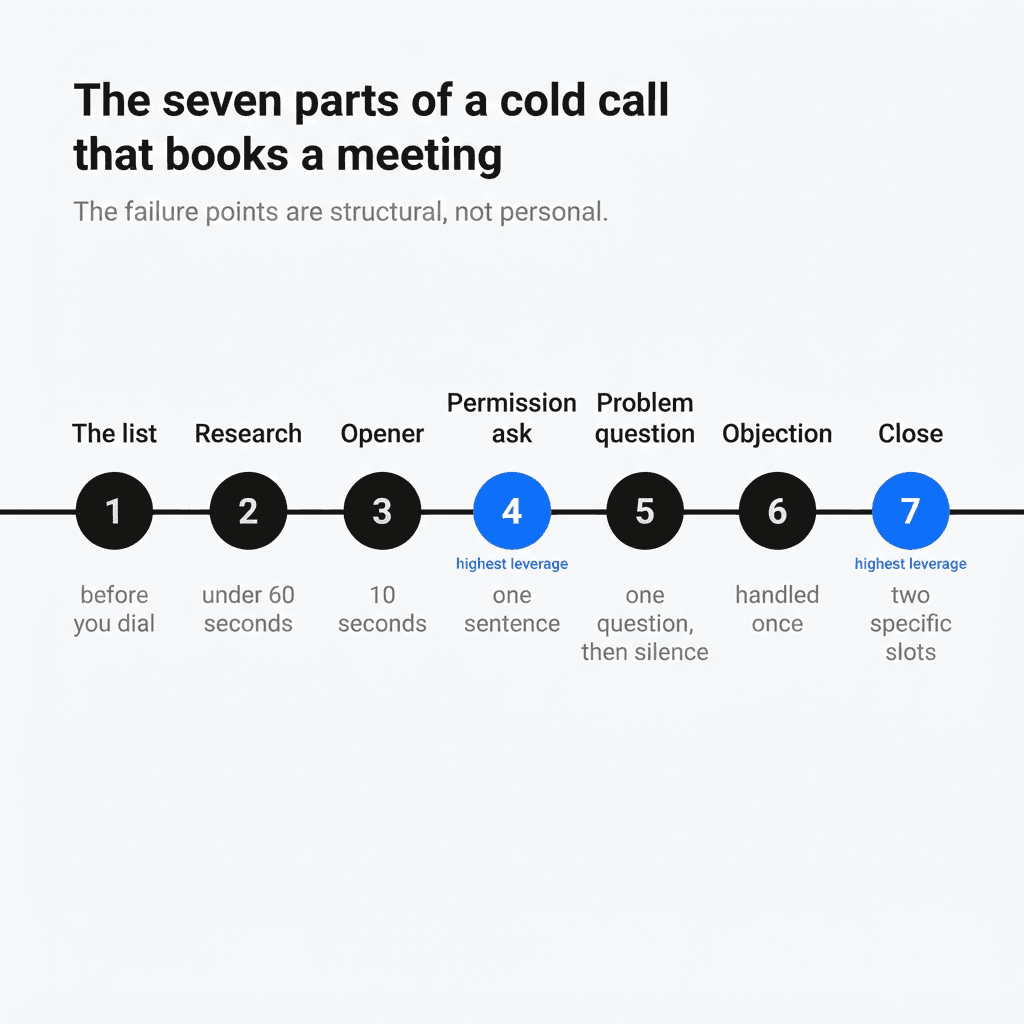
Every script below follows the same five stages. Read one carefully, understand why each line is there, and the rest will make sense in thirty seconds each.
The five stages: introduction → permission → reason for the call → pitch for the meeting → close for a specific time.
Square brackets are yours to fill. The note under each script explains the line that does the work.
What the call data says a script should do
Most script collections give you words and no evidence. Gong Labs published the evidence in 2018, from 90,380 recorded cold calls, comparing the calls that booked a meeting with the calls that did not.
| Measure | Calls that booked a meeting | Calls that did not |
|---|---|---|
| Average call length | 5:50 | 3:14 |
| Rep talk share | 55% talk, 45% listen | 42% talk, 58% listen |
| Prospect's longest uninterrupted stretch | 3.5 seconds | 8 seconds |
| Speaker switches a minute | 77% more | baseline |
| "We" to "I" ratio | 35% higher | baseline |
Source: Gong Labs, "Essential cold calling tips", Chris Orlob, 2018 (archived 2026-10-08). The length and talk-share figures are printed in chart images on the article and were read in a browser.
Four things follow for a cold calling script:
- The script should do most of the talking. Reps on successful calls talked 55 percent of the time. Listen-more advice comes from discovery calls. On a cold call your job is to sell the meeting, and Gong's own advice is to save the "top priorities" questions for the meeting itself.
- The opening buys the call. Successful calls ran almost twice as long. The permission ask exists to get you past the first ten seconds into the next five minutes.
- State the reason early. Opening with the reason for the call lifted success 2.1 times over Gong's 1.5 percent baseline (Gong Labs, 2018). Every script below says why you called within its first two sentences.
- Keep the exchange quick. A good call is short turns on both sides: 77 percent more speaker switches a minute, with the prospect talking in bursts of 3.5 seconds.
Limits: Gong sells conversation-intelligence software, and these are its customers' calls, which lean towards funded B2B software teams. The study is from 2018. A real estate or insurance call may run differently, and nobody has published a dataset that would tell you.
1. B2B SaaS, cold, no prior touch
You: Hi Sarah, it's Alex Morgan from Northwind. I know I'm an interruption. Can I have 30 seconds to tell you why I called, and then you can tell me to go away?
Prospect: Go on.
You: Thanks. I called because you're hiring three account executives this quarter. Every company I talk to that hires three at once ends up with the same problem about four months later: two of them are still not at quota. Is that on your mind at all, or have you got ramp figured out?
[Stop talking. Wait.]
Prospect: It's a bit of a concern, yeah.
You: Then it's worth twenty minutes. I'll show you how two teams your size cut ramp, and you can judge whether any of it applies. Do you have your calendar handy?
Why it works. The permission ask turns Sarah from someone being talked at into someone who made a decision. Gong's 2024 data scored this permission pattern at 11.18 percent success (Gong Labs, 2024). The research fact, three AEs hiring, is specific and checkable in sixty seconds. The single question uses her words, ramp and quota. When she says yes, the script goes straight to the meeting. Gong's article calls "Do you have your calendar handy?" the best cold-call close its author has seen, though it publishes no figure for it.
The line that does the work: "and then you can tell me to go away". An explicit exit is what stops the reflex hang-up.
2. Cold call script for B2B, blunt version, for senior titles
You: Sarah? Alex Morgan from Northwind. This is a cold call. Do you want to hang up, or do you want the 30-second version?
Prospect: [laughs] Go on then.
You: You've got four people doing manual quality checks on invoices. Northwind automates most of that. I'd like to find out in one question whether it matters to you, so I don't send an email you won't read. Is invoice processing something anyone there is complaining about?
Why it works. Senior people respond well to compression and honesty, and badly to warmth they did not ask for. Naming the cold call outright usually earns a laugh, and the laugh is the permission.
Use when: the title is VP or above, or the market is heavily called.
3. Real estate cold calling script: expired listing
You: Hi, is this Mark? Mark, it's Dana Reyes with [Brokerage]. I saw your home on [Street] came off the market on Friday. I'm calling because I sell in that neighbourhood and I had two buyers ask about that street last month. Before I say anything else, are you still hoping to sell, or have you decided to stay put?
Prospect: We're still trying to sell.
You: OK. What do you think went wrong the first time?
Why it works. Every agent in the market dials the expired list on the same morning, so the differentiator is the specific buyer claim, which must be true, and a second sentence that asks about him. "What do you think went wrong" lets the seller diagnose their own listing, which usually brings up price without you raising it.
Never say: "I noticed your listing expired." Every other agent said that already this morning.
Compliance: expired and FSBO owners are consumers. Scrub the National Do Not Call Registry and stay inside the calling hours for the owner's state. The state-by-state calling hours guide quotes each rule.
4. Real estate cold calling script: for sale by owner
You: Hi, is this the owner of the property on [Street]? It's Dana Reyes with [Brokerage]. I'm calling about buyers, and I'm not asking to list your home. I have buyers looking in that area and I wondered whether you'd work with an agent who brings you one.
Prospect: Depends on the commission.
You: Fair. If I bring a buyer, would you pay a buyer's agent commission, or are you set on doing the whole thing yourself?
Why it works. FSBO sellers are called constantly by agents who want the listing, so opening on buyers resets the frame. A buyer-side conversation is one they will have.
5. Insurance cold calling script: aged lead
You: Hi, is this Maria? Maria, this is Chris Patel with [Agency]. You asked for a quote on [product] a while back and I'm following up, probably later than you'd like. Did you end up getting covered?
Prospect: Yeah, we went with someone.
You: Good, glad you're covered. Out of curiosity, what did you end up paying? I ask because rates on [product] moved in [month] and half the people I call are paying last year's number.
Why it works. Aged leads have been called by several agencies, so leading with the request she made avoids sounding like the next one in the queue. "Glad you're covered" makes the follow-up question sound like curiosity.
Compliance: aged leads do not carry consent forward reliably. Verify the source and scrub the Do Not Call registry before every campaign.
6. Recruiting, candidate approach
You: Hi Priya, it's Sam Lee from [Agency]. Not a spam call. I'm recruiting for a [role] at a company in [city] and your name came up. Have you got two minutes, or should I try you this evening?
Prospect: I'm not really looking.
You: Most of the good people aren't. Can I tell you the two numbers, salary and the thing that makes this role unusual, and you can tell me if it's worth a conversation?
Why it works. "Not a spam call" earns four seconds. Offering the evening acknowledges that candidates cannot talk at their desk. "Most of the good people aren't" turns the not-looking objection into a compliment.
The rule: lead with the numbers. A candidate who is not looking will listen to a salary figure and will tune out a company description.
7. Recruiting, business development to a hiring manager
You: Hi James, it's Sam Lee from [Agency]. I know you get called by recruiters constantly, so I'll be quick. I've got a [role type] who's interviewing this week and I saw you have that role open. Do you want me to send you their profile, or are you not taking agency candidates for it?
Why it works. It leads with supply. A hiring manager with an open role will give thirty seconds to a specific candidate, and will give none to a recruiter's introduction.
8. The gatekeeper
Gatekeeper: Can I ask what it's regarding?
You: Of course. It's Alex Morgan from Northwind. It's a cold call. I'm hoping to talk to [Name] about how they're handling [specific thing]. If they're busy, is there a better time to try?
Why it works. Gatekeepers are trained to detect evasion and let honesty through. Sounding like you already know the person is the tactic that gets you blocked for good. Asking for a better time treats them as an ally. The gatekeeper guide covers AI call screening too.
Never: claim you were asked to call, imply a prior relationship, or say "it's a personal matter". All three are recognised instantly and burn the account.
9. The voicemail
Sarah, it's Alex Morgan from Northwind, 415-555-0199. I'm calling about your three new AE hires and ramp time. If that's not a live problem I won't call again. 415-555-0199. Thanks.
Why it works. Under fifteen seconds. The number given twice, at the start and the end, because nobody writes down the first one. One specific reason, and a stated limit on further calls.
What a voicemail actually does. Gong's 2024 analysis (a stated 300M+ cold calls) found callbacks are rare. The measurable effect is on email: replies rose from 2.73 percent with no voicemail to 5.87 percent after one or two. The cost is on the phone: the connect rate on later dials fell from 7.18 percent to 5.17 percent, 28 percent lower (Gong Labs, 2024). Leave one or two, paired with an email, and stop. The voicemail scripts guide has ten more.
10. The second attempt, three days later
You: Sarah, Alex Morgan from Northwind again. I left you a message Tuesday about ramp time for your new AEs. Last try from me unless you tell me otherwise. Have you got 30 seconds?
Why it works. Naming the previous attempt removes the awkwardness of pretending it did not happen. "Last try from me unless you tell me otherwise" sets a real deadline, and it only works if you honour it.
11. The referral, warmest version
You: Hi Tom, it's Alex Morgan from Northwind. [Name] at [Company] suggested I call you. They mentioned you're dealing with the same [problem] they were. Is that fair, or has [Name] oversold it?
Why it works. The name goes in the first sentence because it is the entire asset. "Has [Name] oversold it" is self-deprecating enough to feel like a real conversation and invites a correction, which starts one.
Only use with permission. Using someone's name without asking them first damages two relationships at once.
The objections every script will meet
Gong's 2024 objection study puts five objections at 74 percent of everything prospects say to push back, and "Not interested" alone at 17 percent (Gong Labs, 2024). Nearly half, 49.5 percent, are dismissive reflexes fired before the prospect has heard the offer. Plan one reframe for each of the top five before you dial. The objection handling guide has a rebuttal for each, sorted by Gong's three types.
How to actually use these
Read verbatim for your first fifty calls. You cannot improvise inside a structure you have not internalised. After fifty, work from a one-page outline of the five stages.
Change one variable at a time. If you change the opener and the question in the same week you learn nothing. Run one version for a hundred dials, then change one line.
Record yourself. The gap between what reps think they said and what they said is only visible on a recording. Check your talk share against Gong's 55 percent and your call length against 5:50.
Track meetings per conversation. A script that raises dials and lowers booked meetings is a worse script. No published benchmark for meetings per conversation met our sourcing standard, so measure your own baseline over your first two hundred conversations and compare each script change against it.
Stop reading when it starts working. The point of a script is to become unnecessary.
Frequently asked questions
- What is the 80/20 rule in cold calling?
- It usually means listen 80 percent of the time and talk 20. Gong's cold-call data points the other way. On 90,380 cold calls analysed in 2018, reps talked 55 percent of the time on calls that booked a meeting and 42 percent on calls that failed. Listening-heavy ratios belong to discovery calls. A cold call has one job, selling the meeting, so a cold calling script should carry most of the talking. The other reading, that 20 percent of your list produces 80 percent of meetings, is a prioritisation rule with no cold-call study behind it that we found.
- What are the 5 stages of cold calling?
- The five stages of a cold call are the introduction (full name and company), the permission ask (thirty seconds, with an exit), the reason for the call, the pitch for the meeting, and the close for a specific time. Gong's 2018 data on 90,380 cold calls supports the order: stating the reason for the call lifted success 2.1 times over the 1.5 percent baseline, and successful calls spent more of their time on next steps. Discovery questions belong in the meeting you book.
- Is B2B cold calling illegal?
- No. B2B cold calling is legal in the US. The FTC's Telemarketing Sales Rule exempts calls between a telemarketer and a business at 16 CFR 310.6(b)(7), apart from sales of nondurable office or cleaning supplies. The exception that catches B2B teams is mobile numbers: the FCC applies its calling hours and Do Not Call rules to wireless numbers, so a founder's or sole trader's cell should be treated as a consumer line. Calling consumers, including the homeowners in the real estate scripts on this page, is legal with Do Not Call scrubbing and calling-hours limits.
- Should you read a cold calling script word for word?
- Read it word for word for your first fifty calls, then work from a one-page structure. A cold calling script's job is to make the five stages happen in order: introduction, permission, reason for the call, pitch for the meeting, close for a specific time. Reps who keep reading verbatim after that sound like they are reading, and that triggers the hang-up the permission ask was built to prevent.
- How long should a cold calling script be?
- One page, with the opening under about 40 seconds before the prospect speaks. The whole call runs longer. In Gong's analysis of 90,380 cold calls (2018), calls that booked a meeting averaged 5:50 and calls that failed averaged 3:14. Gong also found the prospect's longest uninterrupted stretch was 3.5 seconds on successful calls and 8 seconds on failed ones, so a good script keeps the exchange short and quick on both sides.
- What should you say when a prospect says 'not interested'?
- Acknowledge it and reframe once: "That's fair, you don't know what this is yet. One sentence and then you can decide." "Not interested" is the most common cold call objection in Gong's 2024 data, 17 percent of all objections, and Gong classes it as dismissive, a reflex fired before the prospect has heard the offer. One reframe is the right amount. If it comes back a second time, thank them and end the call.
How to cite this page
Abhi Chawla. "Cold calling scripts that work, with the call data behind each line." MRR Nerds, 2026-10-08. https://www.mrrnerds.com/guides/cold-calling-scripts. Accessed 2026-10-16.
The underlying vendor data is published at /data under CC BY 4.0. Cite the dataset for numbers, this page for the analysis.