A Spam Likely label is the most expensive thing that can happen to an outbound team, because it is invisible. Nobody tells you. Connect rates fall, reps assume the list got worse, and six weeks later somebody calls their own desk number from a personal phone and sees it.
Who decides your number is spam
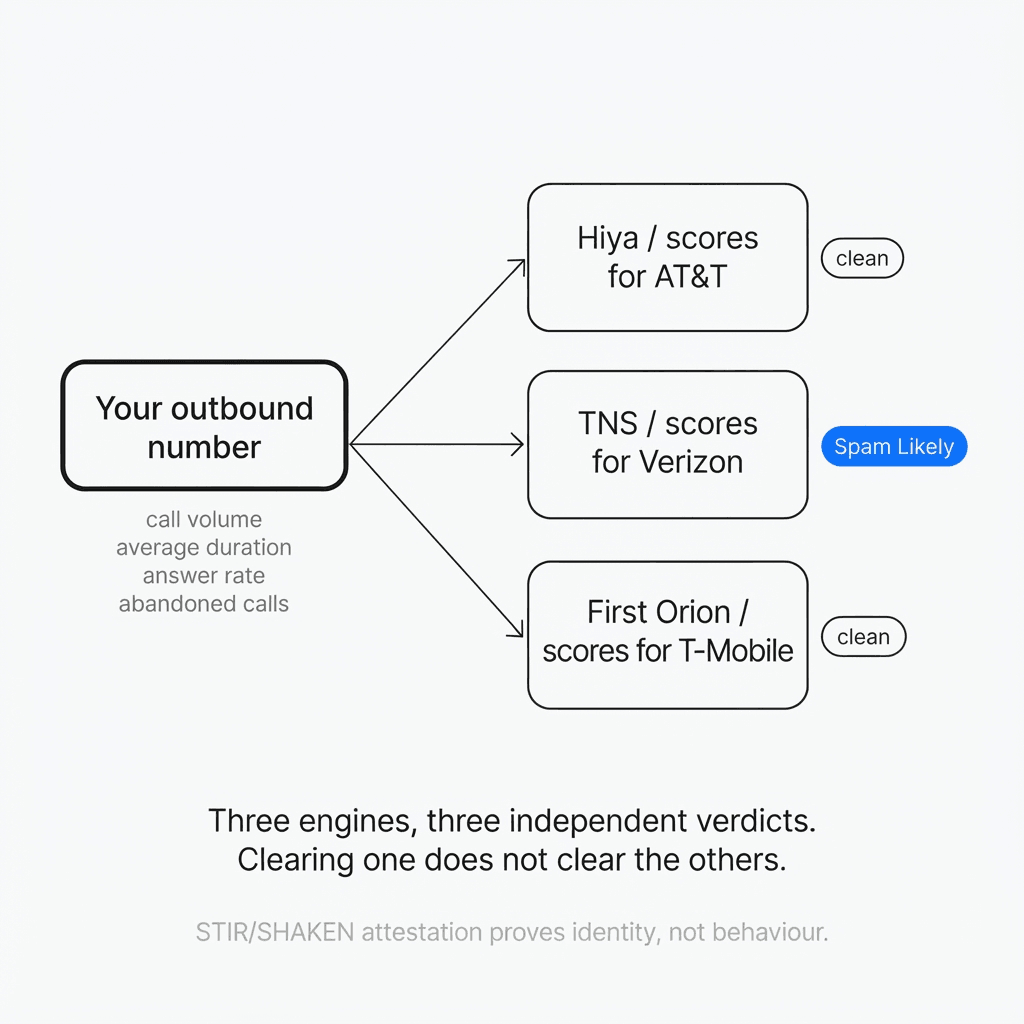
Three analytics companies score calls for the three big US networks. The carriers buy the scoring and print the label.
| Network | Label the person you call sees | Analytics engine | Who says so |
|---|---|---|---|
| T-Mobile | Scam Likely | First Orion | T-Mobile and First Orion's own post on the 2017 Scam ID launch |
| Verizon | Potential Spam, Robo Caller or Potential Fraud | TNS, by wide report | Verizon's Call Filter FAQ names only "our third party spam analytics provider" |
| AT&T | Spam warning in Call Protect / ActiveArmor | Hiya | Hiya's 2018 press release on co-developing Call Protect |
They score independently, with their own models and their own data. A number can be clean on AT&T and flagged on T-Mobile. There is no single score to check.
Verizon publishes the most detail on what its labels mean. Verizon's Call Filter FAQ defines three incoming-call labels: Potential Spam ("unwanted callers that may be calling indiscriminately or inappropriately to a large number of recipients"), Robo Caller ("automated caller with a pre-recorded message") and Potential Fraud. A sales team placing many short calls is the textbook case for the first of those.
Why your phone number is coming up as Spam Likely
None of the engines publishes its model. The signals consistently reported across the industry:
Call volume from a single number. High, sustained volume from one number is the entry condition for scrutiny.
Average call duration. Short calls look like robocalls. A number whose average call lasts nine seconds is behaving like a dialer that hangs up on voicemail.
Answer rate. The strongest signal. A number nobody answers is, statistically, a number nobody wants to hear from.
Abandoned calls. A connected call with nobody on the line is the clearest robocall signature. That is why parallel dialing carries the highest flagging risk of any dialing mode.
User reports. Anyone can report a number in their carrier's app. A handful of reports on a low-volume number moves it faster than thousands of calls on a well-behaved one.
Inherited history. A recycled number can arrive already labelled. Check a new number before you load it into a dialer.
How many calls before Spam Likely
The most common question has no published answer. The working figure on this site is about 100 to 150 dials a day from one number with a low answer rate, and it is an editorial estimate from operator experience. No engine has confirmed it.
The ratio matters far more than the volume. Two numbers:
| Number A | Number B | |
|---|---|---|
| Dials per day | 200 | 80 |
| Answer rate | 20% | 3% |
| Conversations a day | 40 | 2 |
| Average duration | 3 min | 12 sec |
| Flagging risk | Low | High |
Number A places more than twice the calls and is much safer, because everything about it looks like a person having conversations. Number B looks like a machine. For most teams the fix is a better list. More numbers come second.
Why STIR/SHAKEN does not help
STIR/SHAKEN authenticates caller ID. An A attestation means your carrier knows who you are and has verified your right to use the number.
It says nothing about behaviour. An A-attested number placing four hundred short unanswered calls a day is an authenticated robocall, and the engines label it accordingly. A vendor that says attestation prevents spam labels is describing a different problem.
How to unspam your phone number, step by step
- Confirm the label. Call your number from phones on all three networks, or pay a monitoring service. Note the exact wording, because it tells you which network's engine flagged you.
- Register at Free Caller Registry. freecallerregistry.com is run jointly by First Orion, Hiya and TNS and costs nothing. One form takes your numbers, business name and contact details; each of the three providers emails its own acknowledgement. The site is explicit that registration "does not guarantee redress", because each provider still runs its own analysis.
- File the carrier-level disputes too. Verizon's Call Filter FAQ sends businesses with a mislabelled number to voicespamfeedback.com, and that form warns a submission "may not result in a change to how future calls are labeled". Hiya's own help article says to start with its free Hiya Connect Number Registration and then request a one-time review. None of the three publishes a turnaround time.
- Fix the behaviour before you file. A request on a number still placing 400 short calls a day gets reversed by the next scoring run.
- Rest the number. Take a flagged number out of rotation for a few weeks.
- Do not simply buy a new number. It is the most common mistake. The behaviour caused the label, so a new number placing the same calls reproduces it. A team churning through numbers monthly has a list problem.
What stops it coming back
1. Rotate numbers properly. Splitting 300 daily dials across 6 numbers puts each at 50 a day, below the range where flagging usually starts. That is why serious dialers hand out numbers in quantity: Readymode includes 30 to 75 per licence, and Koncert sells managed caller ID reputation with a health heat map. On a bring-your-own-Twilio setup a local number costs $1.15 a month, so a pool of ten is $11.50.
2. Use local presence. A number matching the prospect's area code is answered more often, and answer rate is the strongest positive signal. It raises connect rate and number health together.
3. Fix the list. Every disconnected, wrong or never-answers record drags the answer rate down. Scrubbing invalid numbers before dialing improves reputation directly.
4. Stop calling people who never answer. In Cognism's 2025 data (204,000+ cold calls and 27,000+ conversations, as stated by Cognism), 93 percent of conversations happened by the third call. A record that has not answered after five dials across two or three weeks is costing reputation with little upside.
5. Brand the call. Branded caller ID shows your business name in place of a bare number, which lifts answer rates. Free Caller Registry asks for the name you want shown, and paid branded-calling products go further.
6. Monitor. Paid services check your numbers against all three engines. Without one, you find out six weeks late.
The parallel dialing warning
If you run or are considering a parallel dialer, this is the cost missing from the pricing page.
Parallel dialing produces abandoned calls by design, generates a high volume of short calls and pulls down average duration: three of the strongest negative signals. Every credible vendor in that category sells number rotation for this reason. One that does not leaves you a bill you pay in connect rate six weeks after signing.
Before buying one, ask two questions: how many numbers do I get, and how does rotation work. Vague answers mean the spam risk is yours.
Updated 6 October 2026: added the carrier label table, Free Caller Registry and the carrier dispute forms with their published caveats, and sourced each engine-to-network pairing. The earlier version said remediation always meant filing with each engine separately; see corrections.
Frequently asked questions
- Why is my phone number coming up as Spam Likely?
- A carrier analytics engine scored your calling pattern as robocall-like. The signals reported across the industry are call volume from a single number, short average call length, a low answer rate, abandoned calls and reports from people you called. A number you were assigned can also carry a previous owner's history. Each network scores separately, so the same number can show as Spam Likely on one carrier and clean on another.
- How do I unspam my phone number?
- Start with Free Caller Registry (freecallerregistry.com). It is free, and one submission goes to First Orion, Hiya and TNS, the analytics companies behind T-Mobile, AT&T and, by wide report, Verizon. Each provider emails its own acknowledgement. The registry says registration "does not guarantee redress", so also use the carrier-level forms: Verizon's voicespamfeedback.com and Hiya's one-time review. Then fix the calling pattern, or the label returns.
- Why is my phone number being flagged as suspected spam?
- Suspected spam, Potential Spam, Spam Risk and Scam Likely are different networks' and apps' wording for the same kind of score. Verizon defines Potential Spam as callers "calling indiscriminately or inappropriately to a large number of recipients". The causes are the same everywhere: many short, unanswered calls from one number, and reports from the people receiving them. The fix is also the same: register the number, then change the pattern.
- What is the difference between Scam Likely, Potential Spam and Spam Risk?
- They come from different networks. T-Mobile labels suspected scams "Scam Likely" through its First Orion-powered Scam ID service. Verizon's Call Filter uses three labels: Potential Spam for indiscriminate high-volume callers, Robo Caller for prerecorded messages and Potential Fraud for impersonation. A legitimate sales team is most often labelled Potential Spam on Verizon and Scam Likely on T-Mobile, because the label reflects the calling pattern, whatever the caller's intent.
- How many calls a day before a number gets flagged as spam?
- No engine publishes a threshold. The figure this site uses, about 100 to 150 dials a day from one number, is an editorial estimate from operator experience, labelled as such. The ratio matters more than the count: 200 calls a day with a 20 percent answer rate and 3-minute conversations looks like a person, while 80 calls at 3 percent with 12-second calls looks like a machine.
- Does STIR/SHAKEN stop Spam Likely labels?
- No. STIR/SHAKEN is caller ID authentication: an A attestation means your carrier knows you and has verified your right to use the number. The analytics engines score what the number does, and authentication tells them nothing about that. An A-attested number placing hundreds of short, unanswered calls a day still gets labelled.
- Does number rotation prevent spam flagging?
- It spreads the load, which delays flagging. Splitting 300 daily dials across 6 numbers puts each at 50 a day, under the range where flagging usually begins. The underlying signals stay the same, so a team with a 2 percent answer rate will eventually flag every number in the pool. Use rotation to buy time while the list gets fixed.
How to cite this page
Abhi Chawla. "Spam Likely: why your phone number is flagged and how to fix it." MRR Nerds, 2026-10-06. https://www.mrrnerds.com/guides/spam-likely. Accessed 2026-10-16.
The underlying vendor data is published at /data under CC BY 4.0. Cite the dataset for numbers, this page for the analysis.