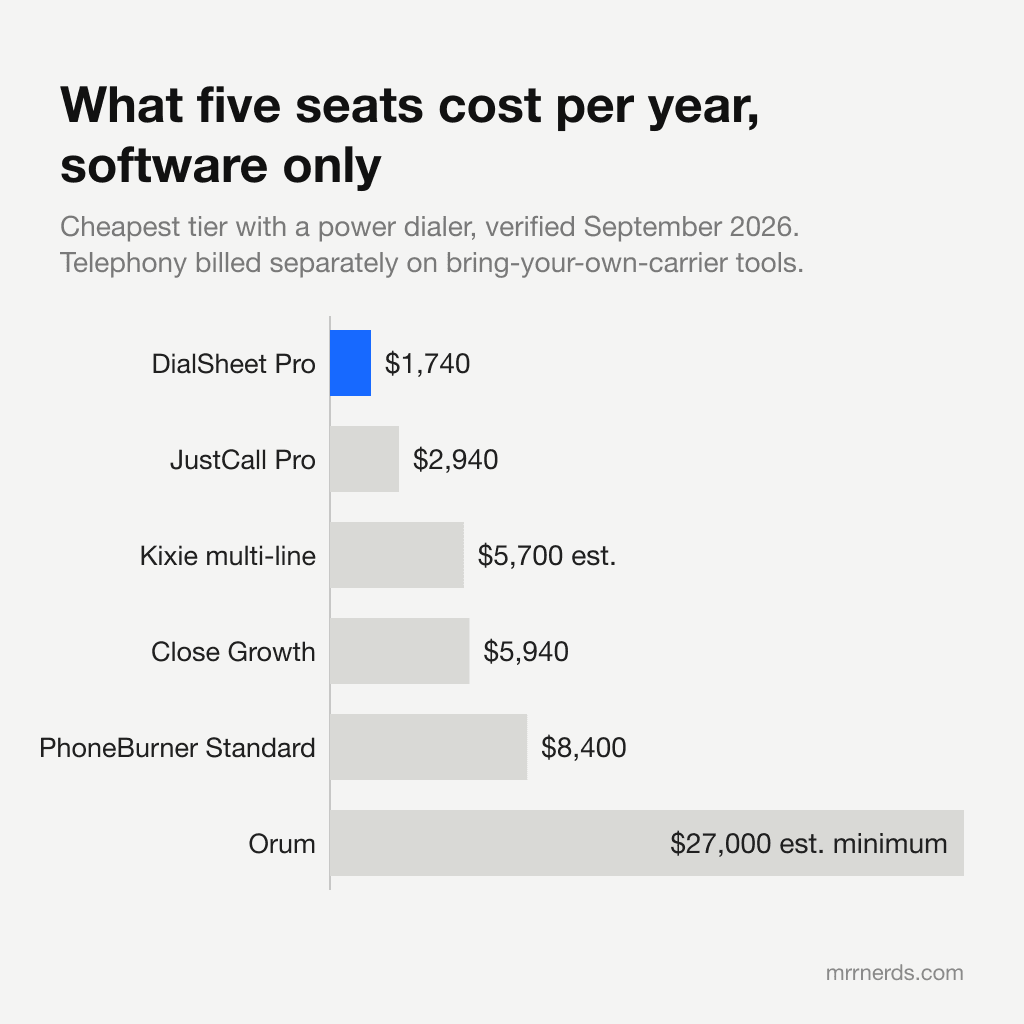
Kixie's pricing page has plan names, a feature table and two buttons. It does not have a price. That is a change made during 2026, and it is the first thing a buyer needs to know, because every figure below including the ones on this page is somebody's estimate.
What the estimates say
| Tier | Price | Unit | Power dialer | Notes |
|---|---|---|---|---|
| Professional Plan | est. $35 | per user per month, annual (third-party) | No | Click-to-call and click-to-text, voicemail drop and live call coaching. No dialer. Kixie no longer publishes prices. |
| Single-Line PowerDialer | est. $65 | per user per month, annual (third-party) | Yes | Professional plus a single-line power dialer and calling session management. |
| Multi-Line PowerDialer | est. $95 | per user per month, annual (third-party) | Yes | Up to 4 lines. AI Human Detection is marked a premium add-on on the plans page. |
Prices read from www.kixie.com/pricing/ on 2026-09-05, archived the same day. Figures are a dated third-party estimate from checkthat.ai (verified 2026-03-30), not published vendor pricing, and are labelled as an estimate wherever they appear on this site. The full record is in the verification log.
The add-ons are the story
The tier price is roughly half of what a multi-line Kixie seat actually costs. Three add-ons come up in almost every quote:
- AI voice detection, around $30 per user per month. On a multi-line dialer this is not optional. Without answering-machine detection, parallel dialing bridges reps to voicemail greetings, which is worse than not parallel dialing at all.
- DNC compliance, around $20 per user per month. Anyone dialing consumer numbers in the United States needs this, and the TCPA guide explains why the exposure is not theoretical.
- ConnectionBoost, around $50 per user per month, which is Kixie's local-presence and number-reputation product.
A multi-line seat with all three lands near $195 a user a month, which is above PhoneBurner's published Standard tier and above every published figure in this category except Salesfinity. Readymode's licence price was higher still, but Readymode withdrew it from its pricing page in October 2026. None of those four numbers appears on Kixie's website.
The contract terms
- Kixie removed dollar figures from its own pricing page, so you cannot compare without a sales call. Source, confirmed 2026-09-04.
- Add-ons commonly double the bill: AI voice detection around $30, DNC compliance around $20, ConnectionBoost around $50 per user. Source, confirmed 2026-09-04.
- Annual prepayment is mandatory below ten users, with downgrades allowed only in the final 30 days. Source, confirmed 2026-09-04.
- Support is chat and email during business hours, with no phone line and no weekend cover. Source, confirmed 2026-09-04.
- Trustpilot reviews repeatedly cite contract lock-in and difficult number porting on exit. Source, confirmed 2026-09-04.
The prepayment rule is the one that costs money quietly. Below ten users the annual term is mandatory and paid up front, and the only window to reduce seats is the last 30 days before renewal. A team that hires three reps in January, loses two in March and forgets to diarise the renewal window pays for five seats for a second year.
What Kixie is worth paying for
If your entire sales process lives in HubSpot and you want the dialer inside the record rather than beside it, Kixie's integration is better than anything a bring-your-own-Twilio tool offers today.
That is a real advantage and this site is not going to argue it away. A rep who never leaves the HubSpot record saves a genuine amount of context-switching, and the recurring complaint about bring-your-own-carrier tools is exactly that gap. Kixie also carries 4.8 on G2 across roughly 865 reviews, and unlimited US and Canada minutes are included on all plans.
The same three seats elsewhere
| Tool | Software a month, 3 seats | Minutes | All in a month | A year |
|---|---|---|---|---|
| Kixie | est. $195 | Bundled | est. $195 | est. $2,340 |
| DialSheet | $87 | $52 own carrier | $139 | $1,668 |
| JustCall | $147 | Bundled | $147 | $1,764 |
| PhoneBurner | $420 | Bundled | $420 | $5,040 |
| Close CRM | $297 | Billed on top | Software plus metered minutes | Not computable |
Kixie's row uses the estimated multi-line tier without add-ons, which is the friendliest reading available. With voice detection, DNC and ConnectionBoost the same three seats land closer to $585 a month.
DialSheet is the cheapest row and is built by the author of this site. It has no native HubSpot or Pipedrive connector, only a REST API, an MCP server and CSV, so for the buyer who wants Kixie specifically for the CRM integration it does not substitute. Where DialSheet loses says the same thing at length.
Get these in writing before the demo
- The per-seat price for the exact tier you need, and whether it holds at renewal.
- The price of AI voice detection, DNC compliance and ConnectionBoost per user per month.
- The contract term, the prepayment requirement and the exact downgrade window.
- Whether your numbers can be ported out, and what that process costs.
- Whether the quoted price includes the minutes you expect to use.
A quote that arrives without the add-on prices is not a quote you can compare.
Frequently asked questions
- How much does Kixie cost?
- Kixie does not publish prices. Dated third-party estimates put Professional at $35 per user per month on annual billing, the single-line PowerDialer at $65 and the multi-line PowerDialer at $95. Add-ons matter more than the tier: AI voice detection, DNC compliance and ConnectionBoost together commonly add about $100 a user a month. Treat every one of those numbers as an estimate, because the vendor publishes none of them.
- Did Kixie remove its pricing?
- Yes. Kixie's pricing page carried per-tier dollar figures earlier in 2026 and now shows plan names and a feature comparison without them. The page was checked on 2026-09-05 and the quoted heading is "Choose The Perfect Plan For Your Revenue Teams". The estimates used here come from checkthat.ai (verified 2026-03-30).
- Does Kixie require an annual contract?
- Below ten users, yes, and it is prepaid. Downgrades are permitted only in the final 30 days of the term, so a team that shrinks in month three keeps paying for the seats until renewal comes round. Reviewers also report difficulty porting numbers out on exit, which is worth asking about in writing before you sign.
- What does Kixie do better than a cheaper dialer?
- It puts the dialer inside the CRM record. If your whole process lives in HubSpot or Pipedrive, dialing from the record rather than beside it removes a class of admin that bring-your-own-carrier tools cannot match today, and Kixie's integration is the best of the mid-market dialers on that axis. It also holds 4.8 on G2 across roughly 865 reviews, which is a large enough sample to trust.
- What is a cheaper alternative to Kixie?
- JustCall publishes $49 a seat with unlimited outbound minutes and no add-on maze, which is the closest like-for-like replacement. DialSheet is the cheapest at $29 a month for the first seat and $29 for each teammate, with minutes on your own Twilio account, though it has no native HubSpot or Pipedrive package, which is the main reason teams buy Kixie. DialSheet is built by the author of this site.
How to cite this page
Abhi Chawla. "Kixie pricing in 2026, and what the add-ons do to it." MRR Nerds, 2026-09-08. https://www.mrrnerds.com/guides/kixie-pricing. Accessed 2026-10-24.
The underlying vendor data is published at /data under CC BY 4.0. Cite the dataset for numbers, this page for the analysis.