Head to head
DialSheet vs PhoneBurner: what the price gap actually buys
PhoneBurner costs $140 to $183 a seat with unlimited calling. DialSheet costs a flat $29 a seat plus wholesale telephony. When the gap is worth it.
Disclosure. DialSheet is built by Abhi Chawla, who also publishes this site. Read the editorial policy.
Pick DialSheet if
Your reps use under about 8,000 talk minutes a month, you want the software free or near-free, and you are comfortable spending five minutes connecting a Twilio account.
Pick PhoneBurner if
Your reps talk for several hours a day, voicemail drop is central to how you work the list, or you want one bundled bill with no separate carrier invoice.
Consider neither if
If you need the dialer inside HubSpot or Pipedrive, neither of these is the answer and Kixie is. If you need genuine parallel dialing on five or more lines, look at Salesfinity at a published $299 month to month, or CloudTalk's ten-line add-on at $39 per user.
DialSheet vs PhoneBurner at a glance
Verified against each vendor's own pricing page on 2026-09-20.
| DialSheet | PhoneBurner | |
|---|---|---|
| Our score | 4.5/ 5 | 3.7/ 5 |
| Cheapest tier with a power dialer | Free plan | $140/user/mo |
| Seat minimum | 1 | 1 |
| Annual contract required | No | No |
| Free plan | Yes | 14-day trial |
| Dialing modes | power, parallel, click-to-call, preview | power, preview, click-to-call |
| Minutes | You connect your own Twilio account and pay Twilio directly at about $0.014 a minute for US outbound plus $1.15 a month per local number, with no markup added. DialSheet's own page quotes the range it expects you to land in, about $0.013 to $0.02 a minute and $1.15 to $2.15 a number. A managed line at $49 a month is available if you do not want a Twilio account, and includes a number and 1,500 minutes. | Unlimited calling is included on every tier, which is the strongest thing about PhoneBurner's pricing. SMS is capped at 1,000 outbound messages a month on Premium. |
| Bring your own Twilio | Yes | No |
| CRM built in | Full CRM | Full CRM |
| AI call summaries | Higher tier | Higher tier |
| Two-way SMS | Limited | Limited |
| G2 | No listing | 4.7 / 5 (~285) |
The disclosure first
DialSheet is built by Abhi Chawla, who also publishes this site. This comparison names the two places PhoneBurner wins outright rather than burying them, because a comparison that never concedes anything is one you should not trust.
Both PhoneBurner and DialSheet Pro offer voicemail drop. PhoneBurner's unlimited minutes can be cheaper at very high talk-time volumes; compare actual billed minutes and the workflow before choosing.
Side by side
| DialSheet | PhoneBurner | |
|---|---|---|
| Software price | $0 free tier, $29/month a seat | $140 to $183/user/month |
| Telephony | Your own Twilio, ~$0.014/min | Unlimited, included |
| Free plan | Yes, permanent, includes the dialer | No, trial only |
| Lines | Up to 5 on Pro | 1 |
| CRM | Full, included | Adequate, included |
| AI transcription and summaries | On Pro | Premium tier only |
| Voicemail drop | No | Yes |
| Open source | Yes, MIT, self-hostable | No |
| Setup | ~5 minutes to connect Twilio | Immediate |
| Support | Community and email | Business hours, better resourced |
| Public review corpus | Effectively none | 4.7 on G2 across ~285 reviews |
The arithmetic, at three team sizes
Reps dialing 150 numbers a working day, 5 percent connect rate, 22 percent voicemail rate, 2.5 minutes of average talk time.
| Team | DialSheet all in | PhoneBurner Standard | Annual difference |
|---|---|---|---|
| 1 rep | ~$46/month | $140/month | ~$1,128 |
| 3 reps | ~$139/month | $420/month | ~$3,372 |
| 10 reps | ~$465/month | $1,400/month | ~$11,220 |
Those are software-plus-telephony totals on both sides. PhoneBurner's column is software only, because its minutes are included.
Where PhoneBurner is worth it
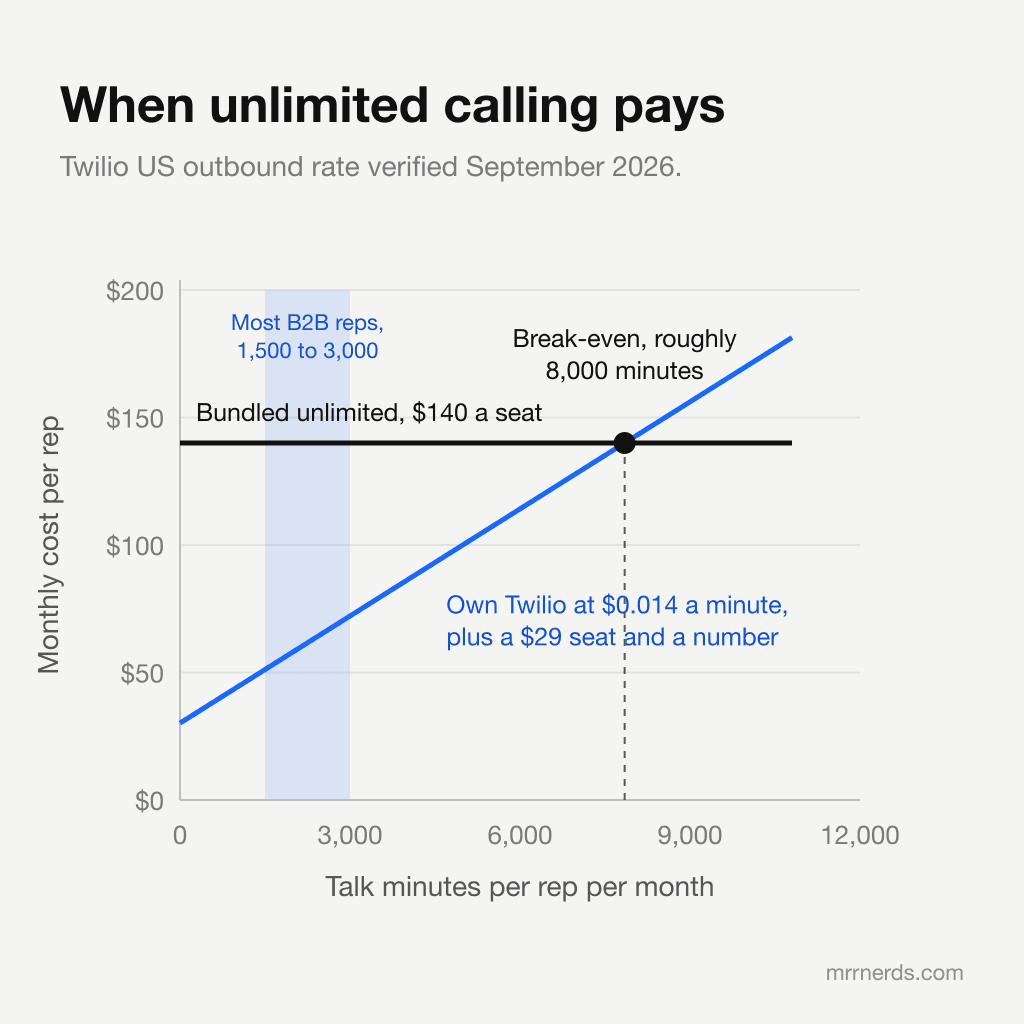
Above roughly 8,000 talk minutes a rep a month. That is roughly 133 hours of talking, and at that point unlimited calling costs less than paying $0.014 a minute. Consumer-facing desks with long conversations reach it. B2B reps essentially never do; the 150-dial-a-day rep above uses about 1,166.
Check your own talk minutes before assuming this does not apply. If you already have a phone bill, the number is on it.
Voicemail drop. Both offer it. DialSheet includes it on Pro: record a message, confirm consent for prerecorded messages, then press V at the beep during a Power Dial call. The parallel dialer can leave the selected recording on machine answers. Compare the workflows on your own calls before paying more for this feature.
The track record. PhoneBurner has 4.7 on G2 across roughly 285 reviews and years of operating history. DialSheet has essentially no third-party review corpus. If your procurement requires an established vendor with public references, that is a legitimate constraint.
Where DialSheet wins
Price, by roughly a factor of three to four all in depending on team size, and the gap widens as you add people because each DialSheet seat costs $29 against PhoneBurner's $140.
The free plan. Not a trial. One user, 500 leads, 500 calls a month, with the actual dialer. That is the cheapest possible way to find out whether outbound works for your business before spending anything.
Multi-line. Up to five lines included in Pro on your own Twilio, or two lines on the $49 managed plan from day one and three once Twilio verifies the business, against PhoneBurner's one. Five is not ten, but one is one.
AI on the cheap tier. Transcription, summaries, extracted next steps and script-compliance scoring are on the $29 plan. PhoneBurner puts transcription on the $183 tier.
Number ownership. On a bring-your-own-Twilio setup the numbers are registered to your account. Leaving means pointing a different app at the same Twilio account, not porting. On PhoneBurner, leaving means a port.
Open source. MIT licensed and self-hostable, so the code and the data are both inspectable.
The setup difference, PhoneBurner: sign up, start calling.
DialSheet: sign up, create a free Twilio account, add a payment method, copy two credentials, paste them in. About five minutes, and it is five minutes inside a telephony console, which some buyers do not want to do.
DialSheet's answer is a managed line at $49 a month with a number and 1,500 minutes included, which removes Twilio entirely. The managed line includes one Pro user and up to three parallel lines after verification. It starts below PhoneBurner's $140 annual-billing rate, but its 1,500-minute allowance is capped: extra minutes cost $25 per 500-minute pack. Compare call volume before choosing.
Which to buy
Run one calculation and one check.
The calculation: your talk minutes per rep per month. Under 3,000, DialSheet is dramatically cheaper. Over 8,000, PhoneBurner is cheaper.
The check: which voicemail and follow-up workflow fits the team? Both DialSheet Pro and PhoneBurner support recorded voicemail drops.
At the example volume above, three DialSheet Pro seats cost about $139/month including the modeled carrier spend, compared with $420 for PhoneBurner on annual billing. Actual minutes and recording charges can change that comparison.
Frequently asked questions
- Is DialSheet cheaper than PhoneBurner?
- Substantially. A three-person team pays about $139 a month all in on DialSheet, being $87 of software plus roughly $52 in Twilio charges at 150 dials per rep per day, against $420 a month on PhoneBurner Standard. That is a difference of roughly $3,372 a year. The gap widens with team size because each added DialSheet seat is $29 against $140 on PhoneBurner.
- Does DialSheet have voicemail drop?
- Yes. DialSheet Pro supports recorded voicemail drop in Power Dial and on parallel-dialer machine answers. Record a message in Settings and confirm consent for prerecorded messages. In Power Dial, press V at the beep; in parallel mode, select a recording for machine answers. Calling charges still apply.
- When is PhoneBurner's unlimited calling actually cheaper?
- Above roughly 8,000 talk minutes per rep per month, which is roughly 133 hours. At that volume PhoneBurner's flat $140 seat costs less than paying about $0.014 a minute on a wholesale Twilio account. A typical B2B rep dialing 150 numbers a day with a 5 percent connect rate uses around 1,166 billable minutes, well below the threshold. Consumer-facing desks with long conversations are the case where it pays.
How to cite this page
Abhi Chawla. "DialSheet vs PhoneBurner: what the price gap actually buys." MRR Nerds, 2026-09-20. https://www.mrrnerds.com/compare/dialsheet-vs-phoneburner. Accessed 2026-10-20.
The underlying vendor data is published at /data under CC BY 4.0. Cite the dataset for numbers, this page for the analysis.