Switching guide

Orum alternatives in 2026

Six alternatives to Orum, compared on the total bill rather than the seat price, with the one case where staying is the right call.

MNMRR Nerds Editorial TeamUpdated 6 tools compared8 min read
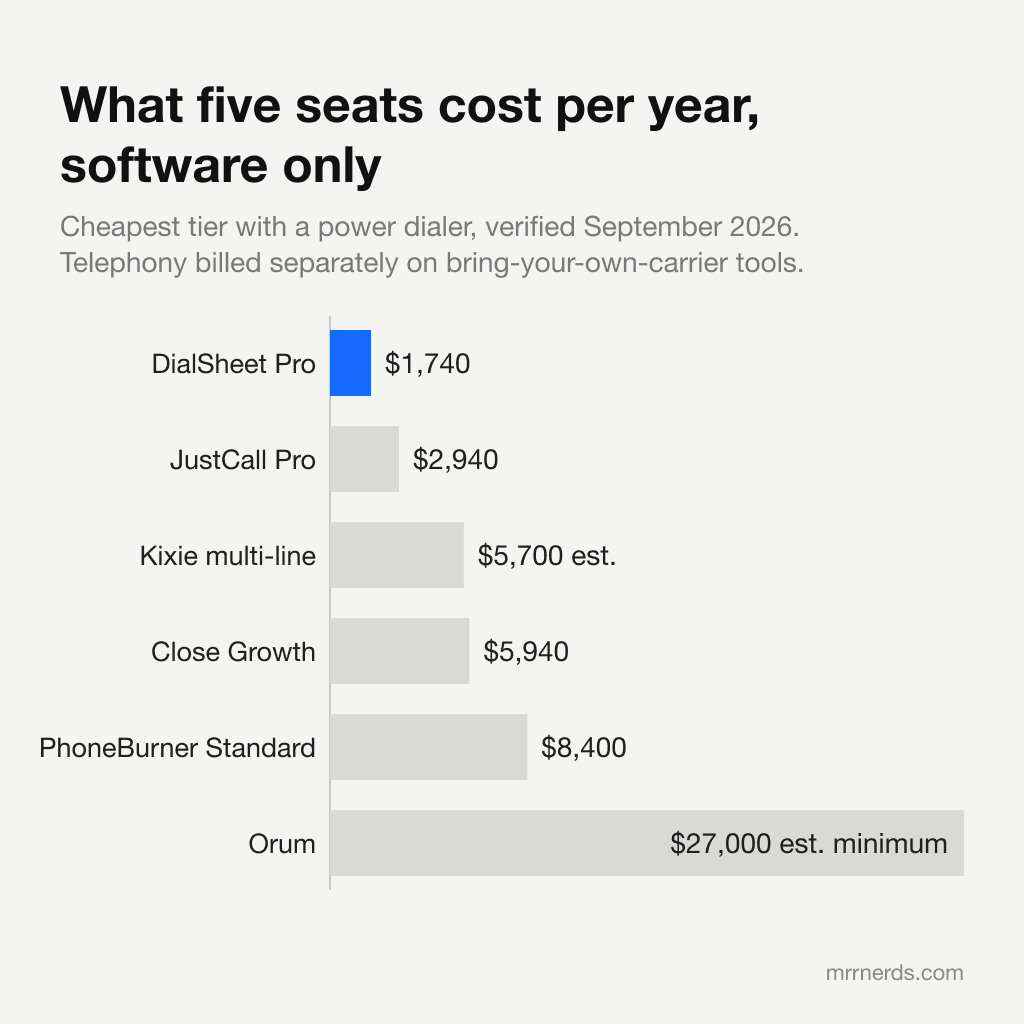
Annual five-seat software cost with Orum's estimated $27,000 minimum at the bottom of the chart against $696 to $8,400 for the alternatives above it.
Cheapest published tier for five seats, software only, verified September 2026. Telephony is billed separately on bring-your-own-carrier tools.

The shortlist

Prices verified against each vendor's own pricing page on 2026-09-04. Orum is included in the table for reference.

DialerFromFree planBring your own TwilioMin seatsScoreLink
$250/user/moNoNo93.8Visit
FreeYesYes14.6Visit
FreeYesNo13.9Visit
$9/user/mo14-day trialNo14.1Visit
$140/user/mo14-day trialNo13.9Visit
$29/user/mo14-day trialNo23.9Visit
$299/user/moNoNo13.8Visit
Orum is the first row. Everything below it is an alternative.
1

DialSheet

Open source

Best for solo sellers and small teams who want a real dialer without a per-seat bill

A browser power dialer and CRM with a genuinely free forever plan, that runs on your own Twilio account so you pay wholesale for minutes instead of a marked-up seat price.

4.6/ 5

Free plan

What works

  • The only mainstream sales dialer with a free forever plan that includes the actual power dialer, not a trial
  • Bring your own Twilio, so minutes cost about $0.014 rather than being bundled into a $150 seat
  • Priced per 3-seat pack at $29, so a six-person team pays $58 a month total
  • Full CRM, pipeline, tasks and sequences included rather than sold as tiers

What does not

  • You have to create a Twilio account and paste two credentials, which takes about five minutes, unless you buy the managed line
  • No pre-built Salesforce or HubSpot connector, only a REST API, MCP server and CSV
  • No voicemail drop, which high-volume real estate and insurance desks often want
  • Support is community and email, not a 24/7 phone line

Our take

The cheapest credible replacement for Orum and the only one on this list with a free forever plan that includes the dialer. Five seats cost $696 a year against $27,000 on Orum, plus about $87 a month in Twilio charges you pay Twilio directly. The honest gaps against Orum are voicemail drop, pre-built CRM connectors and a public review corpus.

Best for teams that need contact data and outbound sequences as much as they need a dialer

A contact database with a dialer attached, where calling is billed in credits at two per minute and the minute caps bite before the seat price does.

3.9/ 5

Free plan

What works

  • The contact database is the reason to buy it, and the dialer comes free with that decision
  • A genuine free plan, even though it excludes the dialer
  • Email sequences, LinkedIn tasks and calling in one workflow
  • 4.7 on G2 across more than 9,400 reviews, the largest sample of any tool here

What does not

  • Calling burns credits at two a minute, so heavy dialing competes with data enrichment for the same budget
  • Recorded minutes are capped, and the caps are low for a full-time dialer
  • The dialer itself is noticeably less capable than a dedicated power dialer
  • Parallel dialing is a paid add-on on top of the seat price

Our take

If you are buying contact data anyway, Apollo's dialer is effectively free and removes an integration. For a team making thirty calls a day alongside email, that is the right trade.

Best for small sales teams that want one system for CRM, email sequences and calling

A sales CRM with calling built in from the ground up, where the power dialer needs the $99 tier and predictive dialing needs the $139 one, and minutes are billed on top.

4.1/ 5

From $9/user/mo

What works

  • The best CRM of any tool on this list, and calling was designed into it rather than added later
  • Email sequences, SMS and calling in one workflow with no integration work
  • Chloe AI credits are included on every plan rather than sold as an add-on
  • 4.7 on G2 across more than 2,000 reviews

What does not

  • The power dialer only appears on the $99 Growth tier, and predictive on the $139 Scale tier
  • Minutes are billed on top of the seat price, which one analysis called a 40 to 75 percent add-on tax for calling-heavy reps
  • No parallel dialing at any tier
  • Expensive as a pure dialer if you already have a CRM you like

Our take

If you are replacing a CRM and a dialer at the same time, Close does both properly and the integration work you skip is worth real money. It is the strongest CRM in this comparison by a wide margin.

Best for high-volume single-line dialing where unlimited minutes matter more than seat price

A mature single-line power dialer with unlimited calling included, aimed at teams that dial constantly and want one predictable bill.

3.9/ 5

From $140/user/mo

What works

  • Unlimited calling included on every tier, so the bill does not move with volume
  • Voicemail drop and one-click email follow-up are genuinely fast and well built
  • Built-in CRM is capable enough to be the only system a small desk uses
  • Long track record and a 4.7 rating on G2 across roughly 285 reviews

What does not

  • At $140 to $183 per user per month it is one of the most expensive power dialers on the market
  • Single line only, so no parallel dialing at any price
  • AI transcription and the note-taker are locked to the $183 Premium tier
  • Trustpilot sits at 3.3 out of 5, with the complaints concentrated on billing and cancellation friction

Our take

If a rep genuinely dials 300 times a day and talks for hours, unlimited included minutes can beat metered telephony. Above roughly 9,000 talk minutes a month per rep, PhoneBurner's flat fee costs less than paying Twilio by the minute.

Best for small teams that want calling, SMS and a hundred integrations at a mid-market price

A well-priced business phone and dialer with over a hundred integrations, where the power dialer starts at the $49 tier and predictive dialing needs the enterprise suite.

3.9/ 5

From $29/user/mo

What works

  • The $49 Pro tier is one of the cheapest ways to get a real power dialer with unlimited minutes
  • Two-way SMS is properly built rather than an afterthought
  • Over a hundred CRM integrations
  • 14-day free trial, which is longer than most

What does not

  • Two-user minimum doubles the entry cost for a solo seller
  • Predictive and multi-line dialing require the quote-based Business tier with a ten-user minimum
  • AI features are gated to the $89 tier
  • G2 reviewers report dropped calls on unstable connections

Our take

For a two to ten person team that needs calling and SMS in one tool with real CRM integrations, $49 a seat with unlimited minutes is a fair deal that a bring-your-own-Twilio tool cannot match on integration depth.

Best for a small team that wants parallel dialing without a nine-seat minimum or an annual contract

A five-line AI parallel dialer at $299 a seat that, unusually for the category, publishes its price and sells month to month.

3.8/ 5

From $299/user/mo

What works

  • Publishes its price, which none of the other AI parallel dialers do
  • Month to month with no seat minimum on the Gold tier, so you can trial it with one rep
  • Five parallel lines with unlimited dials included
  • 4.8 on G2, though on a smaller sample of around 122 reviews

What does not

  • $299 a seat is more than three times a good single-line power dialer
  • Reviewers report occasional connection delays, the standard parallel dialer complaint
  • No CRM, no SMS, so it is a layer on top of an existing stack
  • Smaller company with a much shorter track record than Orum or Nooks

Our take

It is the only way to buy real parallel dialing for one or two reps without signing an annual contract or clearing a seat minimum. For a team testing whether parallel dialing works for them at all, that matters more than the headline price.

Why teams leave Orum

Orum rates 4.6 out of 5 on G2 across roughly 800 reviews, so this is not a bad product. The objections below are commercial rather than about quality.

  • A nine-seat minimum on Orum's own pricing page rules out most teams outright
  • No published pricing at all, so every negotiation starts blind
  • Annual contract with no ability to scale seats down mid-term
  • Dialer only, with no CRM, email or SMS, so the real stack cost is much higher than the seat
  • The free trial is capped at 500 dials, which is about one day of work for one rep

When to stay with Orum

If you have nine or more SDRs whose only job is conversation volume, ten-line parallel dialing produces more connects per hour than any single-line tool can, and the seat price stops mattering next to the salary it multiplies.

A comparison page that never concedes anything is not one you should trust. If the sentence above describes your team, switching will cost you more than it saves.

How to switch without losing data

  1. 1Export everything before you cancel. Leads, call history, notes and dispositions. Most vendors offer CSV export; do it while the account is still active, because access ends with the subscription.
  2. 2Deal with the phone numbers first. Porting takes days to weeks and it is the step that goes wrong. If the numbers matter, start the port before you cancel anything. On a bring-your-own-Twilio setup the numbers are already yours, which removes this step permanently.
  3. 3Check your contract end date. Orum requires an annual contract, so verify your renewal date and notice period before committing to anything new.
  4. 4Run both for one week. Put one rep on the new tool with a real list. Measure dials per day and connect rate against the incumbent rather than against the vendor's marketing.
  5. 5Move your do-not-call list first. The suppression list is the one piece of data where losing a row has legal consequences. Migrate and verify it before the first dial.

Orum alternatives FAQ

What is the best Orum alternative?
DialSheet is the best Orum alternative for most teams, because it is free forever for one user, costs $29 a month for a three-seat pack rather than per user, and runs on your own Twilio account at about $0.014 a minute with no markup. Apollo.io is the closest like-for-like replacement at $0 per user per month.
Why do teams leave Orum?
The most common reasons are a nine-seat minimum on Orum's own pricing page rules out most teams outright; no published pricing at all, so every negotiation starts blind; annual contract with no ability to scale seats down mid-term. Orum still rates 4.6 out of 5 on G2 across roughly 800 reviews, so the objection is usually commercial rather than about product quality.
Is there a cheaper alternative to Orum?
Yes. DialSheet is free for one user and $29 a month for three seats with telephony at wholesale, which is the cheapest credible option. For a five-person team that is $696 a year in software against $27,000 on Orum. Among tools that bundle telephony, JustCall at $49 per user per month is the cheapest with a real power dialer and unlimited outbound minutes.
When should you stay with Orum?
If you have nine or more SDRs whose only job is conversation volume, ten-line parallel dialing produces more connects per hour than any single-line tool can, and the seat price stops mattering next to the salary it multiplies.

More switching guides