The measured benchmark: 44 dials a day
The Bridge Group's 2025 sales development report surveyed 351 B2B companies in 2024 and 2025. Its median SDR does 112 activities a day:
| Activity | Median per day |
|---|---|
| Phone dials | 44 |
| Emails | 41 |
| LinkedIn touches | 19 |
| Text and other | 8 |
| Total | 112 |
Those reps average 4.1 quality conversations a day, which Bridge reports as the first rebound in the study's history.
The split by team type matters more than the median. Phone-centric teams average 56 dials and 4.6 quality conversations a day. Email-centric teams average 28 dials and 3.4. Doubling the dials bought about a third more conversations.
These are company-reported survey figures, and nobody exported call logs. They are still the largest dataset we found that reports dials per rep per day with a named sample.
Where "52 calls a day" comes from
Search this question and the top answers say 52. The figure appears on Focus Digital's 2025 benchmark page, an agency compilation that names its source studies but gives no sample size and no weighting. Its own industry table averages about 69 calls a day, so the headline does not follow from the data under it. Secondary summaries of earlier Bridge Group editions quote figures between 46 and 52, which is the most likely origin; we could not read those editions directly.
Until 12 October 2026 this page also opened with 52. It now uses the 2025 Bridge figure.
What a day of dials produces
Bridge's phone-centric pair gives a conversation rate of 8.2 percent, or one quality conversation per 12.2 dials. Two measured datasets land close to it. Allo logged 72,339 cold calls on its power dialer between July and September 2026: 26.0 percent reached a person and 7.4 percent became a conversation of a minute or more. Belkins logged 175,000+ B2B dials in 2025 and reached a live person on 9.9 percent.
Meetings are the slower number. Belkins reports about one meeting per 370 dials end to end, with 4.6 percent of conversations booking. Combining Belkins' meeting rate with each volume below is our arithmetic across two datasets, so read it as an order of magnitude:
| Daily dials | Source of the volume | Conversations at 8.2% | Working days per meeting at 1 per 370 |
|---|---|---|---|
| 44 | Bridge 2025 median | 3.6 | 8.4 |
| 56 | Bridge 2025, phone-centric | 4.6 | 6.6 |
| 80 | A common team target | 6.6 | 4.6 |
| 120 to 200 | Power dialer, editorial estimate | 10 to 16 | 1.9 to 3.1 |
A rep on the median books two or three meetings a month from calls alone. That is why dial targets exist, and why tooling is the first lever.
What tooling changes
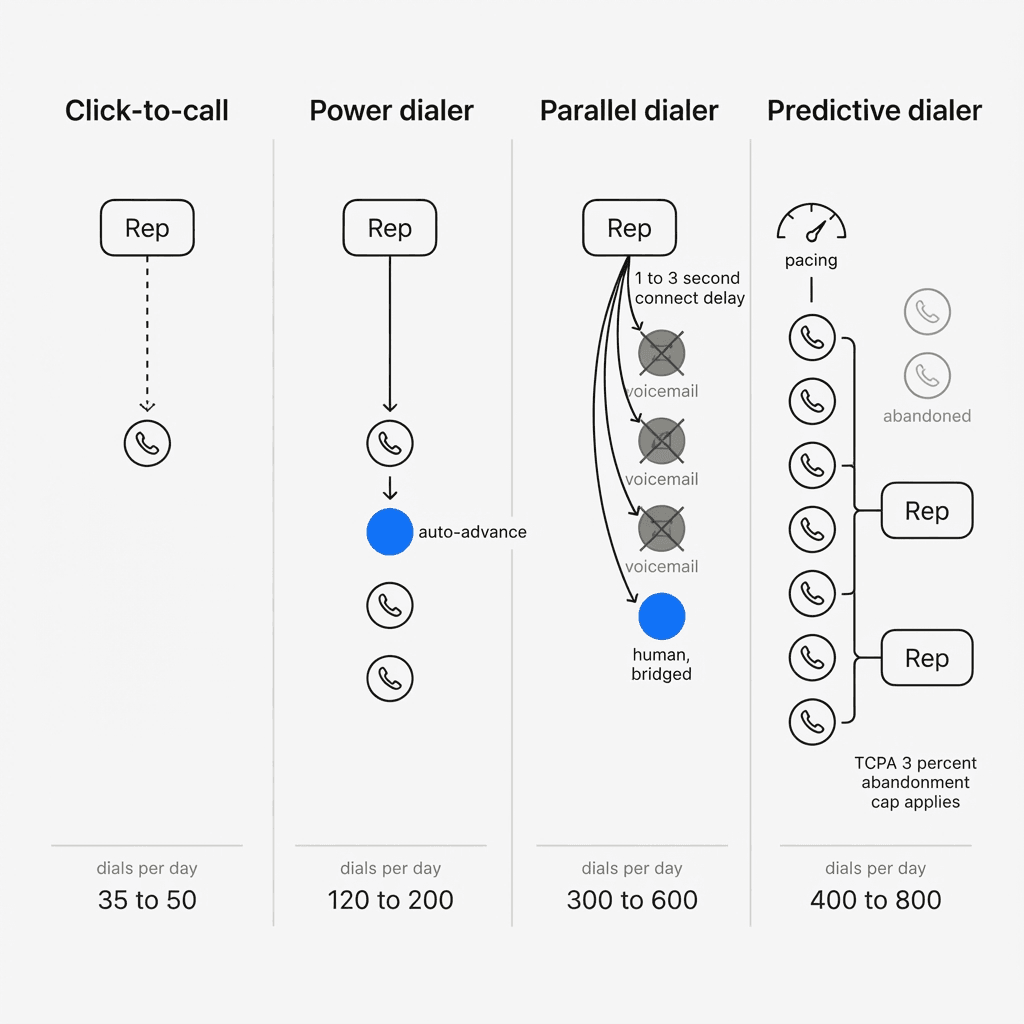
No published dataset we found measures dials per rep per day by dialer type. These ranges are MRR Nerds editorial estimates, recorded as such in our methodology. Per hour assumes 4 hours of actual dialing, two sessions of two hours.
| Method | Dials per day (estimate) | Per dialing hour | Conversations at 8.2% |
|---|---|---|---|
| Manual, spreadsheet or CRM | 35 to 50 | 9 to 13 | 3 to 4 |
| Power dialer, one line | 120 to 200 | 30 to 50 | 10 to 16 |
| Parallel dialer, 3 to 4 lines | 300 to 600 | 75 to 150 | fewer than 25 to 49, because answered lines get dropped |
The manual range sits right around Bridge's measured median of 44, which is the check on the estimate. The power-dialer range is two to four times that. It comes from removing the dialing, ringing and logging between calls. The rep does not talk faster.
Vendors quote higher. Klenty's parallel dialer page advertises 150 to 350 dials per hour and "10+ conversations per hour", with no stated sample or day length. Plan against the low end of any vendor figure.
Dials by vertical and role
The only per-industry figures we found are Focus Digital's, with no sample disclosed. They are directional at best:
| Segment | Calls a day (Focus Digital, 2025) |
|---|---|
| B2C telemarketing rep | 135 |
| Real estate | 98 |
| Insurance | 85 |
| Financial services | 72 |
| Outbound SDR, appointment setting | 68 |
| Technology and SaaS | 55 |
| Account executive | 35 |
The shape is believable even if the precision is not. Consumer lists with short calls run the highest volumes. Account executives with a handful of named accounts run the lowest. Note that Focus Digital's SDR figure of 68 is above Bridge's measured 56 for phone-centric teams.
How to actually make 100+ dials in a day
Prepare the list the night before. Research inside a dialing session is the largest drain on dial count. Cap it at 60 seconds per prospect and do it before the session.
Block two uninterrupted sessions. Two two-hour blocks give the 4 dialing hours the table above assumes.
One-key dispositions. If logging an outcome takes three clicks, 150 calls cost hundreds of clicks.
Sort the list by time zone. Work each region in its own best windows. Cognism's 2026 report names 10 to 11am and 2 to 3pm as the best windows; see the best time to cold call.
Never leave the session to send an email. Queue the follow-up as a task and send them in a block afterwards.
Why a higher dial count can make things worse
Number reputation. Our editorial estimate, recorded in the Spam Likely guide, is that carriers start labelling a number somewhere around 100 to 150 dials a day when its answer rate is low. Rotate numbers before you raise targets.
Preparation collapses. A rep chasing a dial count skips the minute of research, and the dial dashboard cannot see the conversations getting worse.
Diminishing returns are already in the data. Bridge's email-centric teams make half the dials of phone-centric teams and still have about three quarters of the conversations.
What to measure instead
- Quality conversations per day. Bridge's 2025 average is 4.1; phone-centric teams 4.6.
- Conversation-to-meeting rate. Belkins measured 4.6 percent in 2025. Measure your own baseline and move it.
- Dials per meeting. Belkins' figure is about 370. If yours is far above it, fix the list and the opener before adding dials.
- Number health. How many of your numbers are flagged. Nobody tracks this until connect rates fall.
If you set one target, make it conversations. A rep with 10 quality conversations a day is running at about twice Bridge's phone-centric average, whether that took 122 dials or twice as many.
Until 12 October 2026 this page stated a 52-dial average with no source, a 4 to 8 percent connect rate, a 10 to 20 percent conversation-to-meeting benchmark, a minute-by-minute breakdown of a manual day and a vertical table, none of them sourced. The change is logged on /corrections.
Frequently asked questions
- How many calls should a cold caller make a day?
- The measured median is 44 dials a day for SDRs and 56 on phone-centric teams, per the Bridge Group's 2025 survey of 351 B2B companies. Set the target from the meeting you need: at Belkins' 2025 rate of about one meeting per 370 dials, two meetings a week takes roughly 148 dials a day, which is power-dialer territory for one rep.
- Is 80 cold calls a day a lot?
- Yes, against the measured benchmarks. 80 dials is 1.8 times the Bridge Group's 2025 SDR median of 44 and 1.4 times the 56 that phone-centric teams average. At Bridge's own conversation rate, 80 dials yields about 6.6 quality conversations, and at Belkins' one meeting per 370 dials, about one meeting every 4.6 days. It is easy on a power dialer and hard by hand.
- How many cold calls can be done in an hour?
- No measured per-hour dataset we could find publishes a per-rep figure, so these are our editorial estimates spread over 4 dialing hours: 9 to 13 an hour by hand, 30 to 50 on a single-line power dialer, 75 to 150 on a parallel dialer. Klenty advertises 150 to 350 dials per hour for its own parallel dialer, a vendor claim with no stated hours or sample.
- How many cold calls a day should a real estate agent make?
- Focus Digital, a marketing agency, puts real estate at 98 calls a day and insurance at 85, against 55 for technology and SaaS. It publishes no sample size, so treat those as directional. They fit the pattern that consumer lists with short calls run higher volumes. Reaching them takes some dialing automation, since our editorial estimate for dialing by hand is 35 to 50 a day.
- How do you make 100 cold calls a day?
- Use a single-line power dialer with auto-advance and one-key dispositions, and dial in two uninterrupted two-hour sessions. Build the list the evening before so no research happens mid-session. Our editorial estimate is 120 to 200 dials a day that way, against 35 to 50 dialing by hand. One hundred is more than double the Bridge Group's 2025 median of 44.
- Is a higher dial count always better?
- No. Belkins' 2025 data shows only 4.6% of conversations booking a meeting, so conversation quality moves results more than raw dials. High volume from one number also gets numbers flagged; our editorial estimate is that carriers start labelling somewhere around 100 to 150 dials a day per number. Track conversations and the conversation-to-meeting rate.
How to cite this page
Abhi Chawla. "How many cold calls per day: the measured median, and what tooling changes." MRR Nerds, 2026-10-12. https://www.mrrnerds.com/guides/how-many-cold-calls-per-day. Accessed 2026-10-16.
The underlying vendor data is published at /data under CC BY 4.0. Cite the dataset for numbers, this page for the analysis.