Who buys the minutes accounts for most of the gap between a $29 teammate seat and a $140 seat. The dialing engines are much closer together than the prices are.
The list
| Tool | Own carrier | Minutes model | Seat price with a dialer | What it means |
|---|---|---|---|---|
| DialSheet | Yes | Your own carrier | $29 | Numbers and recordings live in your account |
| Myphoner | Yes | Your own carrier | $27 | Numbers and recordings live in your account |
| CloudTalk | Partial | Bundled in the seat | $49 | Supported on higher tiers or by arrangement |
| RingCentral | Partial | Bundled in the seat | $65 | Supported on higher tiers or by arrangement |
The other 17 sell you the minutes: 11 bundle them into the seat price, two meter them at their own rate, and four do some of each depending on the tier and the destination.
The arithmetic, one rep
At 150 dials a day, twenty working days, a 5 percent connect rate and the voicemail and rounding behaviour described in the cost model:
| Item | Amount |
|---|---|
| Dials a month | 3,150 |
| Billable minutes | 1,166 |
| Minutes at $0.014 | $16 |
| Numbers at $1.15 | $1 |
| Telephony a month | $17 |
That is the whole carrier bill for one full-time caller. A bundled seat at $140 is charging $123 a month above it for software plus the vendor's own margin on minutes, which is a defensible thing to sell and a large number to pay without checking.
Where the model flips
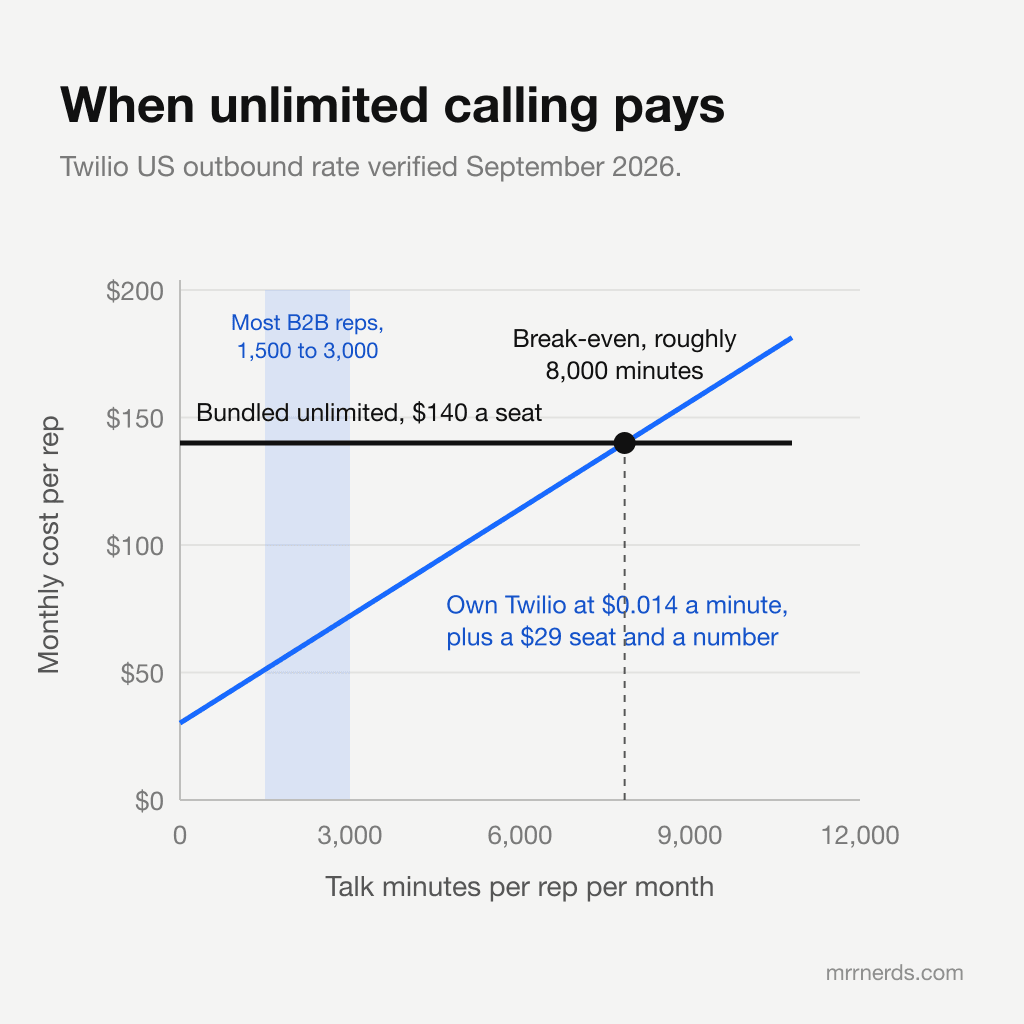
Bundled unlimited calling wins above about 8,000 talk minutes a rep a month. The chart above is that crossing point. Three kinds of desk regularly cross it:
- Recruiters running twenty-minute screening calls back to back.
- Insurance and mortgage desks where a quote conversation runs long.
- Any team where the same rep handles inbound as well as outbound.
If your reps talk for more than 133 hours a month, price PhoneBurner properly before assuming wholesale is cheaper. The break-even guide works through it.
What you get besides the price
The numbers are yours. Prospects call back the number that called them. When the phone numbers live in the vendor's account, changing dialers means changing numbers, and every callback to the old number goes nowhere. In your own carrier account the numbers move with you.
The recordings are yours. Call recordings sit in storage you control, which matters for anyone with a retention obligation.
The rate falls as you grow. Committed volume pricing at a carrier is a conversation you can have directly. Inside a bundled seat, there is nothing to negotiate except the seat.
What you take on
You create the carrier account, paste two credentials, and reconcile a second invoice. You provision numbers and handle spam-label remediation yourself when a number gets flagged, which the spam labelling guide covers. For a team without an ops person, a vendor that handles all of it inside one bill is a reasonable thing to pay for, and DialSheet sells a managed line at $49 a month for exactly that reason.
DialSheet is built by the author of this site. Its weaknesses are on its review and on where DialSheet loses, and Myphoner at $27 a user is the other bring-your-own-carrier option worth pricing next to it.
Frequently asked questions
- Which dialers work with your own Twilio account?
- DialSheet and Myphoner connect to a Twilio account you own, so minutes are billed to you at wholesale with no markup. CloudTalk and RingCentral offer carrier connections on higher tiers or by arrangement. The other 17 tools sell you minutes as part of a seat price or meter them at their own rate.
- How much does Twilio actually cost for cold calling?
- About $0.014 a minute for US outbound and $1.15 a month per local number, read from Twilio's published rate card on 2026-09-04. One rep at 150 dials a day is roughly 1,166 billable minutes a month, or about $17 including numbers. Carriers bill per call rounded up to the whole minute, and a picked-up voicemail bills a full minute, both of which the [cost model](/methodology/telephony-model) accounts for.
- When are bundled unlimited minutes cheaper?
- Above roughly 8,000 talk minutes a rep a month, which is the point where PhoneBurner's $140 flat seat costs less than the same minutes at $0.014. Recruiters, insurance desks and anyone holding long conversations all day can cross it. A B2B SDR at 1,500 to 3,000 talk minutes a month does not.
- What is the catch with bringing your own carrier?
- You create the carrier account and paste two credentials, which takes a few minutes, and you get a second bill to reconcile. You also take on number provisioning and any spam-label remediation yourself rather than leaving it with the vendor. In exchange the numbers, recordings and call logs sit in an account you control, so switching dialers does not mean losing the phone numbers your prospects call back.
How to cite this page
Abhi Chawla. "Which sales dialers let you bring your own carrier." MRR Nerds, 2026-09-08. https://www.mrrnerds.com/guides/bring-your-own-carrier-dialers. Accessed 2026-10-24.
The underlying vendor data is published at /data under CC BY 4.0. Cite the dataset for numbers, this page for the analysis.